How do I build a relationship with a hiring manager before they have a role for me?
The short answer: the hiring manager is usually visible months before the role is. In our hiring-history file, 508 of the 561 companies with senior engineering roles open — 90.6% — also have a Manager-level role or above open right now. The people you need to know are already on the company's public job board, under their own titles. The relationship is not a trick. It is a short list, three people per company, and one useful touch every three to four weeks for three to six months.
The short answer: the hiring manager is usually visible months before the role is. In our hiring-history file, 508 of the 561 companies with senior engineering roles open — 90.6% — also have a Manager-level role or above open right now. The people you need to know are already on the company's public job board, under their own titles. The relationship is not a trick. It is a short list, three people per company, and one useful touch every three to four weeks for three to six months.
This post shows you who those people are, how to find them, and what to say — with the numbers from our own data, not from networking advice.
The people are already there
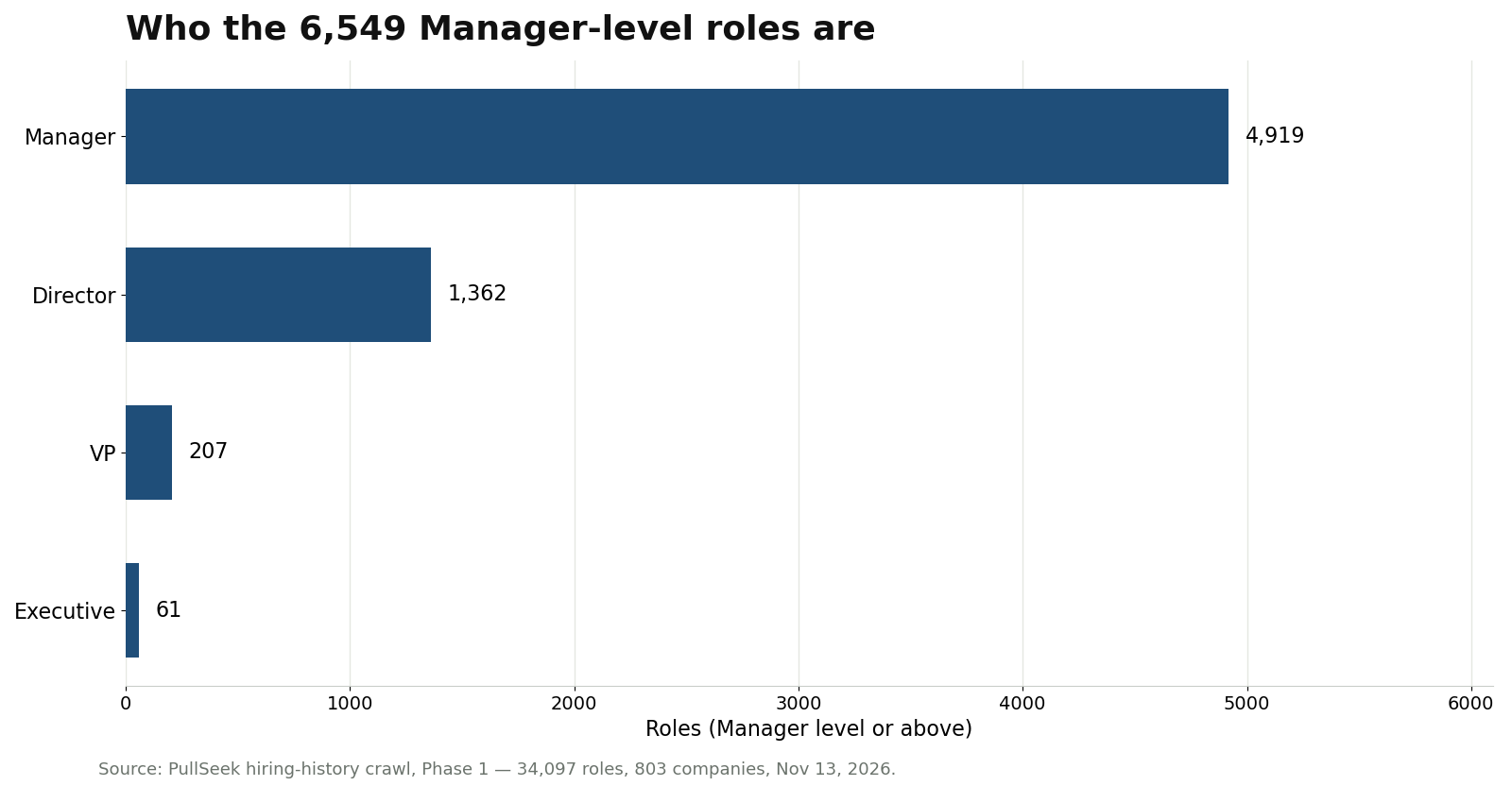
Start with the scale. Our file holds 34,097 open roles across 803 companies. Of those, 6,549 roles — 19.2% of everything in the file — are Manager-level or above: 4,919 Manager, 1,362 Director, 207 VP, and 61 Executive. These are the people who own hiring decisions, or sit one step above the person who does.
For senior engineering specifically, the picture is sharper. There are 5,980 senior engineering roles across 561 companies. Of those 561 companies, 508 have a Manager-level role or above open at the same time. And 5,862 of the 5,980 senior engineering roles — 98.0% — sit at a company that has a Manager-level role open. If a company is hiring senior engineers, it is almost certainly also hiring — or has recently hired — the people who will manage them.
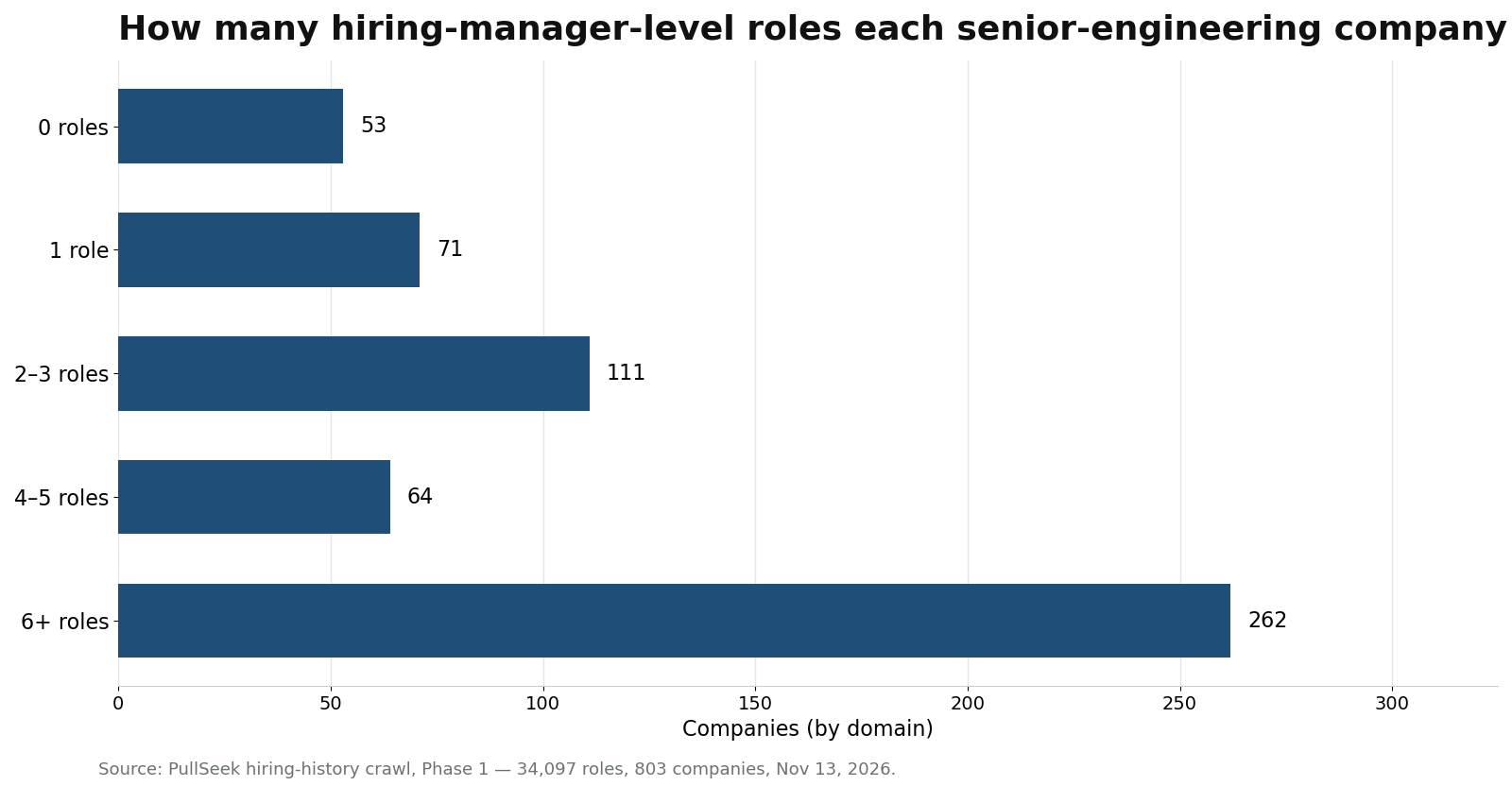
The median company with senior engineering roles open has 5 Manager-level roles open. The distribution is wide: 71 companies have exactly 1, 111 have 2–3, 64 have 4–5, and 262 have 6 or more. Those 262 companies with 6 or more Manager-level roles hold 5,008 of the 5,980 senior engineering roles — 83.7%. The companies hiring the most engineers are also the companies with the deepest bench of managers to know.
The biggest benches are concentrated in the obvious names: OpenAI has 200 Manager-level roles open, Stripe 182, Anthropic 166. But you do not need a famous company. You need ten companies whose engineering problems you understand — and at 508 of 561 companies, the manager is findable.
There are two narrower groups worth naming. First, the direct hiring managers: 509 roles carry the title "Engineering Manager," spread across 185 companies — and all 185 are companies with senior engineering roles open. Second, the peers: 1,550 Staff and Principal engineering roles across 298 companies. The peer is often the better first contact than the manager. A staff engineer will answer a technical question; a hiring manager will not answer a cold pitch.
And 139 of the 561 senior-engineering companies have a VP-level role or above open — 268 VP and Executive roles in total. The VP is not your first contact. The VP is the person whose arrival tells you a team is about to be built. A new VP of Engineering is the earliest public signal that senior roles are coming under them.
Why this works — and what it is not
The reason to build the relationship early is the same reason the referral numbers look the way they do. In Ashby's analysis of more than 38 million applications across 93,000 jobs, 3% of inbound applicants reached an interview, against 40% of referred candidates. A referral is not a shortcut around a fair process. It is the process. The interview is a conversation with a person the team has already met — and "already met" is something you can arrange months in advance, on purpose.
The other number that matters: 45.6% of developers say they are not considering a move at all, in the Stack Overflow Developer Survey 2025. The people a hiring manager most wants are the people who are not applying. If you are one of them, your advantage is not your resume. It is that you are reachable, known, and already credible when the role appears.
What this is not: it is not networking as a numbers game. Ten companies, three people each, is thirty relationships. That is the whole list. It is also not a request for a job. You do not have a role to ask for — that is the point. You are building the relationship before there is anything to ask for, which is exactly why it works: the other person has nothing to say no to.
The three people per company
For each company on your list, find three people.
The likely hiring manager. Start with the Engineering Manager roles — 509 of them across 185 companies — or any Manager-level role with "engineer" in the title: 752 of those across 240 companies, and 238 of the 561 senior-engineering companies have one. If there is no engineering-titled manager role, a Manager-level role in the org that owns the product is close enough. Read their public work first: talks, blog posts, open source, papers. If you cannot say what they care about, you are not ready to write to them.
The team lead. A Staff or Principal engineer on the team you would join — 1,550 of those roles across 298 companies. The lead is the person who can tell you whether the team is actually good, and whether the manager is someone worth working for. They are also the person most likely to reply to a specific technical question, because it is a question about their work, not about you.
One peer. Someone at your level, doing the work you would do. The peer is your reality check and, later, your internal advocate. Peers refer people they respect. Managers hire people their team vouches for.
Fifty-three of the 561 senior-engineering companies have no Manager-level role open at all — 118 senior engineering roles sit at those companies. If your target company is one of them, start with the lead and the peer. The manager will appear. When they do, you will already know two people on their team.
What to say — and how often
The first note is one paragraph, and it is not about you. It is about their work: something specific you noticed — a talk, a post, a design decision, a problem they are clearly working on — plus one thing you have built that is relevant, plus a question worth answering. If the note could be sent to any company, delete it and start over. A generic note does not build a relationship. It trains the other person to ignore you.
Then the rhythm. One useful touch every three to four weeks, for three to six months. A useful touch is: something you shipped that rhymes with their problem; a short comment on their work that shows you read it; a question that is genuinely hard and specific to their team. It is not "just checking in." Checking in is a tax on their attention with nothing in return. A useful touch is a deposit.
Three to six months is the honest window. A relationship that starts the week a role posts is not a relationship. A relationship that starts six months before is, by the time it matters, simply someone the manager knows. PullSeek's own model runs on the same window: we match people to a manager's potential needs every 3–6 months, in small sets of 5–8, because that is how long trust takes and how short a hiring manager's attention is.
And keep it quiet. You are employed. A direct note to one person is invisible to your employer. A public "open to work" badge is visible to everyone and effective with no one.
The timing signal to watch
Manager hiring is active right now. Of the 2,763 Manager-level roles in our file that carry a true posting date, 1,063 — 38.5% — were posted in the 30 days before our fetch on November 13, 2026. That share is high partly because dated roles skew recent — the crawl captured currently open roles, and older postings have mostly closed — so read it as a lower bound on activity, not a trend. What it does tell you: the managers you would build relationships with are being hired now, in volume. The window is open.
The sequence to watch is the same one our earlier posts established: leadership hiring comes first. Of the 561 companies with senior engineering roles open, 508 also have a Manager-level role or above open. When a new manager appears, the team under them follows. If you are building the relationship with the manager as they arrive, you are months ahead of the posting for the roles under them.
What PullSeek does differently
PullSeek exists because doing this by hand for more than a few companies is slow.
We watch 101,498 fast-growing companies, starting with the US. We predict which roles each one is likely to hire in the next 12 months — the role, the level, and the profile that fits. We map the people behind each predicted role: the likely hiring manager, the team lead, the peers. And we draft the introduction to a specific person, which you approve before anything is sent.
The prediction is the point. A job board tells you what is open now. We tell you what is likely to open next, so the relationship starts before the posting — when it still matters.
Every prediction is graded. When the window closes, we compare the prediction against the job description the company actually published. That score is the product. If the predictions are wrong, nothing else matters.
You do not need PullSeek to do this. Ten companies, three people each, one good note, every three to four weeks — that works on its own. PullSeek does it at a scale no person can: every company, every signal, every quarter. The work is the same. The coverage is not.
The bottom line
You do not build a relationship with a hiring manager by asking for a job. You build it by being useful to a specific person, about a specific problem, months before there is a role to discuss. The people are findable — 508 of 561 companies hiring senior engineers have a Manager-level role open right now. The list is short: ten companies, three people each. The cadence is slow: one useful touch every three to four weeks. The payoff is that when the role appears, you are not an applicant. You are someone they already know.
Methodology
Figures in this post were computed from PullSeek's hiring-history crawl, Phase 1 file: 34,097 roles across 803 companies (by domain), fetched November 13, 2026, from public Greenhouse, Ashby, and Lever job boards. Role levels are as listed on the boards; 14,668 rows (43.0%) carry no level label. Manager-level or above means a level of Manager, Director, VP, or Executive: 6,549 roles across 648 companies (Manager 4,919; Director 1,362; VP 207; Executive 61). Senior engineering roles are roles with 'engineer' in the title and a level of Senior, Staff, Principal, Lead, Director, or Manager: 5,980 roles across 561 companies. Of those 561 companies, 508 have a Manager-level role or above open, and 5,862 of the 5,980 senior engineering roles (98.0%) sit at those companies. Manager-level roles per senior-engineering company: median 5; 0 roles: 53 companies; 1 role: 71; 2–3 roles: 111; 4–5 roles: 64; 6+ roles: 262. The 262 companies with 6+ Manager-level roles hold 5,008 of the 5,980 senior engineering roles (83.7%). "Engineering Manager" titled roles: 509 across 185 companies, all 185 of which have senior engineering roles open. Manager-level roles with 'engineer' in the title: 752 across 240 companies; 238 of the 561 senior-engineering companies have one. Staff and Principal engineering roles: 1,550 across 298 companies. VP and Executive roles: 268 across 160 companies; 139 of the 561 senior-engineering companies have one. Posting dates are true dates only where the board publishes them (Ashby and Lever); Greenhouse publishes no posting dates. Of the 2,763 Manager-level roles with a true date, 1,063 (38.5%) were posted in the 30 days before the November 13, 2026 fetch.
The wider hiring-history corpus holds 51,129 deduped role rows across 1,611 companies crawled. The PullSeek company directory holds 101,498 companies. The Inc 5000 database holds 5,003 US high-growth companies.
External figures: Ashby referrals analysis — 40% of referred candidates reached an interview vs 3% of inbound applicants, from 38 million applications across 93,000 jobs, January 2021 to December 2024 (published May 2025); Stack Overflow Developer Survey 2025 — 45.6% of developers not considering a move.
Related insights
Start with the work, not the posting.
PullSeek predicts the roles companies will hire in the next 12 months and introduces you to the people inside before the job exists. Your first connected role is free.
Get started