How do I get a warm introduction to a hiring manager instead of cold-applying?
The short answer: a warm introduction is a specific person vouching for you, for a specific reason, to a specific person — and the person you need to reach is usually findable, because they are hiring too.
The short answer: a warm introduction is a specific person vouching for you, for a specific reason, to a specific person — and the person you need to reach is usually findable, because they are hiring too.
A cold application asks a stranger to judge you from a document. A warm introduction asks someone they trust to vouch for you. The difference shows up in the numbers. In Ashby's analysis of more than 38 million applications across 93,000 jobs, from January 2021 to December 2024, 3% of inbound applicants reached an interview. Referred candidates reached an interview 40% of the time.
That gap is not about the resume. It is about trust, transferred from one person to another. The introduction is the transfer.
The hiring manager is findable — they are hiring too
The first thing to know is that the person you need to reach is not hidden. In most cases, they are visible in the same data as the roles they will hire for.
We crawled the public job boards of 803 companies and recorded 34,097 open roles. Of those, 6,281 are Director-level or above — Director or Manager — spread across 635 companies. That is 79.1% of the companies in the file with at least one senior leadership role open. Manager-titled roles of all kinds total 9,621, across 684 companies, 85.2% of the file.
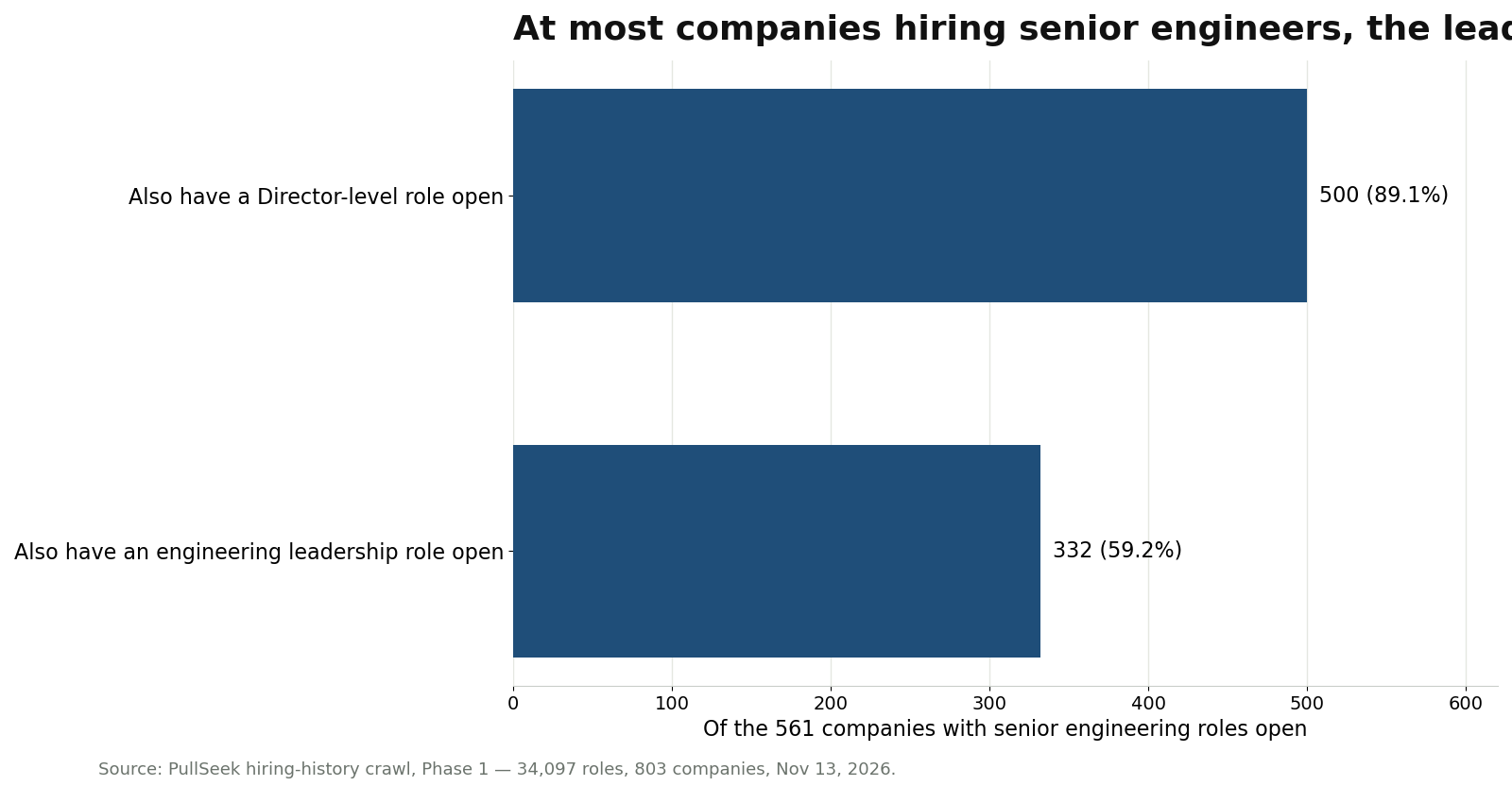
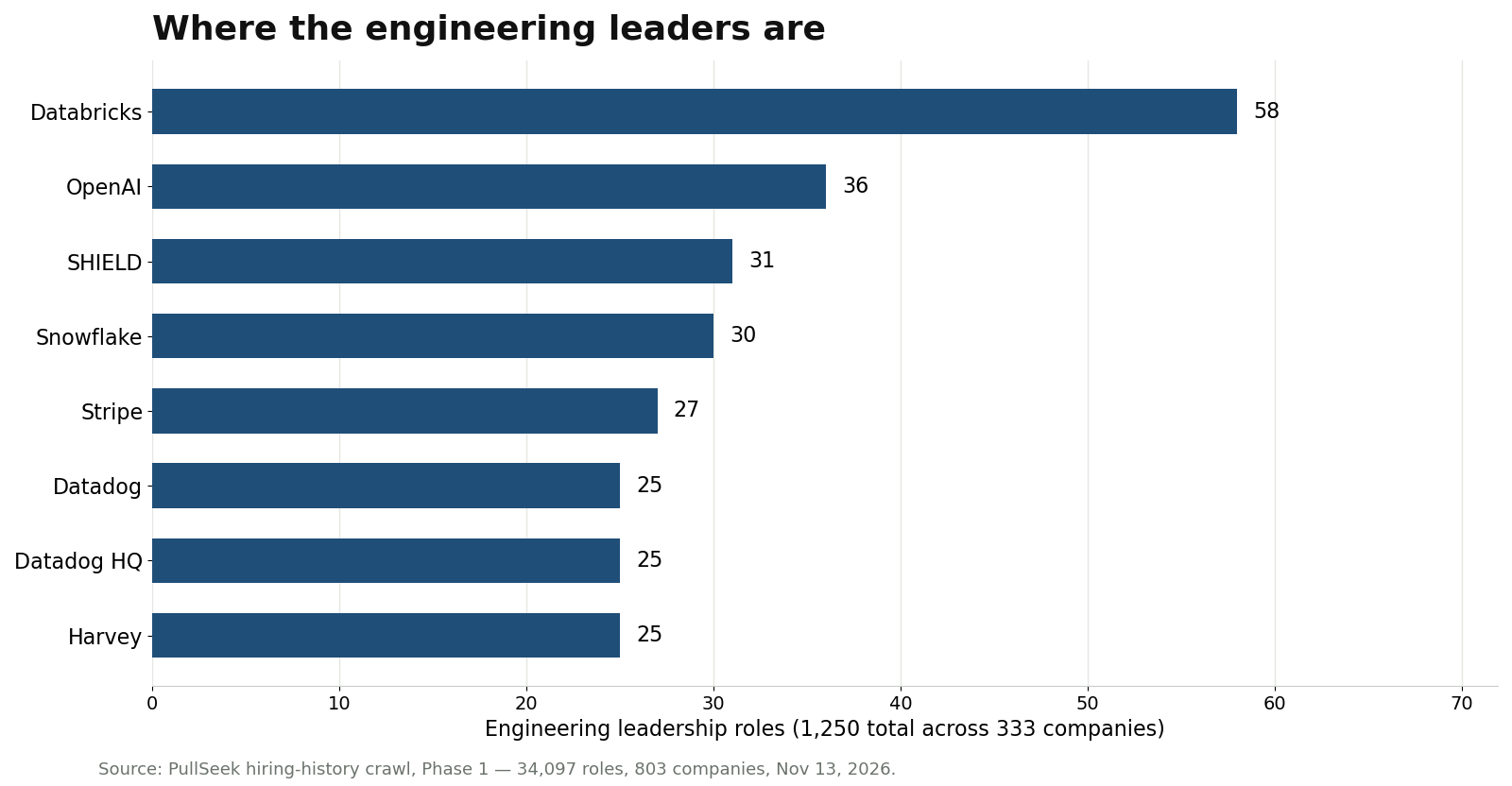
For engineers specifically, 1,250 roles carry an engineering leadership title — Manager, Director, VP, Head, or Lead, with 'engineer' in the title — across 333 companies. And the overlap is what matters: of the 561 companies with senior engineering roles open, 500 also have a Director-level role open, and 332 have an engineering leadership role open. In other words, at 6 in 10 of the companies hiring senior engineers, the engineering leader you would need an introduction to is themselves visible — either hiring, or already in the role.
The hiring manager is not a name on a hidden org chart. They give talks. They write about incidents. They maintain open-source projects. They post about the team they are building. The introduction starts with knowing who they are and what they care about, and that information is public.
Why the introduction converts
A referral is not a shortcut past the interview. It is a different kind of interview — one that starts before the application exists.
When a hiring manager receives a cold application, they have to answer one question: is this person worth an hour? They have almost no information, and the cost of a wrong yes is an hour of their time. So the bar is high, and most applications fail it. That is the 3%.
When the same manager receives a warm introduction, the question is different. Someone they trust has already answered it. The recommender's reputation is on the line, which is why recommenders are careful about who they vouch for. The manager is not judging a document. They are having a conversation with a person a trusted colleague has already described, in specific terms.
The interview that follows is also different. A referred candidate is not being screened from zero. The manager already knows, from the recommender, what the candidate has built and how they work. The conversation starts further along — about the team's actual problems, not about whether the candidate is real.
None of this means a referral guarantees a hire. The Ashby figure is about reaching an interview, not receiving an offer. But reaching the interview is the hard part. Everything after it is a conversation about the work.
How to earn the introduction
An introduction is earned, not requested. Nobody owes you a vouch. The people who give good introductions protect their own reputation, and they should. Here is how it actually happens.
1. Through someone who has seen your work. This is the strongest path. A former colleague, a manager, a peer from another team — someone who watched you build something real and would work with you again. The introduction they write is specific: "she built the billing system at her last company, she can own this." That specificity is the whole value.
You build this over years, by being the person other engineers want to work with again. The practical version: stay in touch with the three or four people whose judgment you most respect, and be useful to them before you need anything. Answer their questions. Review their designs. Send them the article that matters for their problem. The introduction is the return on that investment, not the start of it.
2. Through your public work. Senior engineers leave traces — talks, blog posts, open source, papers, incident write-ups. A hiring manager who has read your work already has an opinion of you before you ever speak. When a mutual connection introduces you, the manager does not have to take the recommender's word for it. They can read the evidence themselves.
This is the slowest path and the most durable. It does not require being famous. It requires being specific — writing about the actual problems you solved, in enough detail that a peer can tell you know what you are talking about.
3. Through the manager's own hiring signal. When a company is hiring senior engineers, the hiring manager is usually the person doing the hiring — and often they are visible doing it. They post about the team. They speak at meetups. They write about the problem they are trying to solve. Reaching out to that person directly, about the work, is not a cold application. It is a conversation with the person who will decide.
The note you send matters more than the channel. One short, specific paragraph: what you noticed about their team's work, what you have built that is relevant, and a question worth answering. If the note could be sent to any company, delete it and start over.
The note itself
Most introduction requests fail in the first sentence. They ask for too much, too soon, with too little to go on.
Do not write: "I'd love to connect" or "I'm interested in opportunities at your company." Those sentences say nothing, and they ask the reader to do the work of figuring out why you wrote.
Do write one paragraph with three things in it. First, what you noticed about their team's work — the specific project, the talk, the post. Second, what you have built that is relevant — one thing, named plainly. Third, a question worth answering — about the problem, not about a job.
Then make the ask small. Not "are you interested in a role." A conversation. Thirty minutes. A question worth answering. Senior engineers will take a call about an interesting problem. They will not take a call about a job description.
And do not ask for a job that does not exist. Ask for a conversation about the work. The job is the outcome of the conversation, months later — not the subject of the first message.
What not to do
Do not ask a loose acquaintance for an introduction to a hiring manager they barely know. A weak introduction is worse than none — it tells the manager that you do not understand how trust works, and it costs the introducer reputation they will not get back.
Do not send the same request to fifty people. Mass outreach is how you get ignored by exactly the people you most want to reach. Senior engineers talk to each other. A lazy note sent to five of them becomes a story told to fifty.
Do not lead with compensation, and do not ask for a resume in the first message. You approached them. The conversation is about the work.
What PullSeek does differently
PullSeek exists because finding the right person, and the right introduction, is hard to do by hand for more than a few companies.
We watch 101,498 fast-growing companies, starting with the US. We predict which roles each one is likely to hire in the next 12 months — the role, the level, and the profile that fits. We map the people behind each predicted role: the likely hiring manager, the team lead, the peers. And we draft the introduction to a specific person, which you approve before anything is sent.
The prediction is the point. A job board tells you what is open now. We tell you what is likely to open next, so the relationship starts before the posting — when it still matters.
Every prediction is graded. When the window closes, we compare the prediction against the job description the company actually published. That score is the product. If the predictions are wrong, nothing else matters.
You do not need PullSeek to do this. Ten companies, three people each, one good note — that works on its own. PullSeek does it at a scale no person can: every company, every signal, every quarter. The work is the same. The coverage is not.
The bottom line
A warm introduction is trust, transferred from one person to another. Earn it from someone who has seen your work, aim it at a hiring manager you can actually find, and make the ask small and specific.
The application asks a stranger to judge you. The introduction lets someone they trust do it instead.
Methodology
Figures in this post were computed from PullSeek's hiring-history crawl, Phase 1 file: 34,097 roles across 803 companies (by domain), fetched November 13, 2026, from public Greenhouse, Ashby, and Lever job boards. Role levels are as listed on the boards; 14,668 rows (43%) carry no level label. Director-level roles (Director or Manager level) total 6,281 across 635 companies. Manager-titled roles (title contains Manager, Director, VP, or Head of) total 9,621 across 684 companies. Engineering leadership roles (title contains 'engineer' and Manager, Director, VP, Head, or Lead) total 1,250 across 333 companies. Senior engineering roles are roles with 'engineer' in the title and a level of Senior, Staff, Principal, Lead, Director, or Manager: 5,980 roles across 561 companies. Of those 561 companies, 500 (89.1%) also have a Director-level role open and 332 (59.2%) have an engineering leadership role open.
The wider hiring-history corpus holds 51,129 deduped role rows across 1,611 companies crawled. The PullSeek company directory holds 101,498 companies. The Inc 5000 database holds 5,003 US high-growth companies.
External figures: Ashby referrals analysis — 40% of referred candidates reached an interview vs 3% of inbound applicants, from 38 million applications across 93,000 jobs, January 2021 to December 2024 (published May 2025).
Related insights
Start with the work, not the posting.
PullSeek predicts the roles companies will hire in the next 12 months and introduces you to the people inside before the job exists. Your first connected role is free.
Get started