How do we reach senior engineers who are not looking?
The short answer: you don't reach them through a job posting. You reach them through their work.
The short answer: you don't reach them through a job posting. You reach them through their work.
A senior engineer who is not looking is not on a job board. They are employed, well paid, and busy. They do not have an "open to work" badge. They do not scroll LinkedIn Jobs. The only place they are visible is in their public work — talks, open source, papers, blog posts — and in the judgment of people who have worked with them.
If your hiring plan starts with a posting, you have already lost this person. The posting reaches people who are looking. The senior engineer you want is not looking. Someone has to go to them, with something specific to say.
Most of the hiring is senior hiring
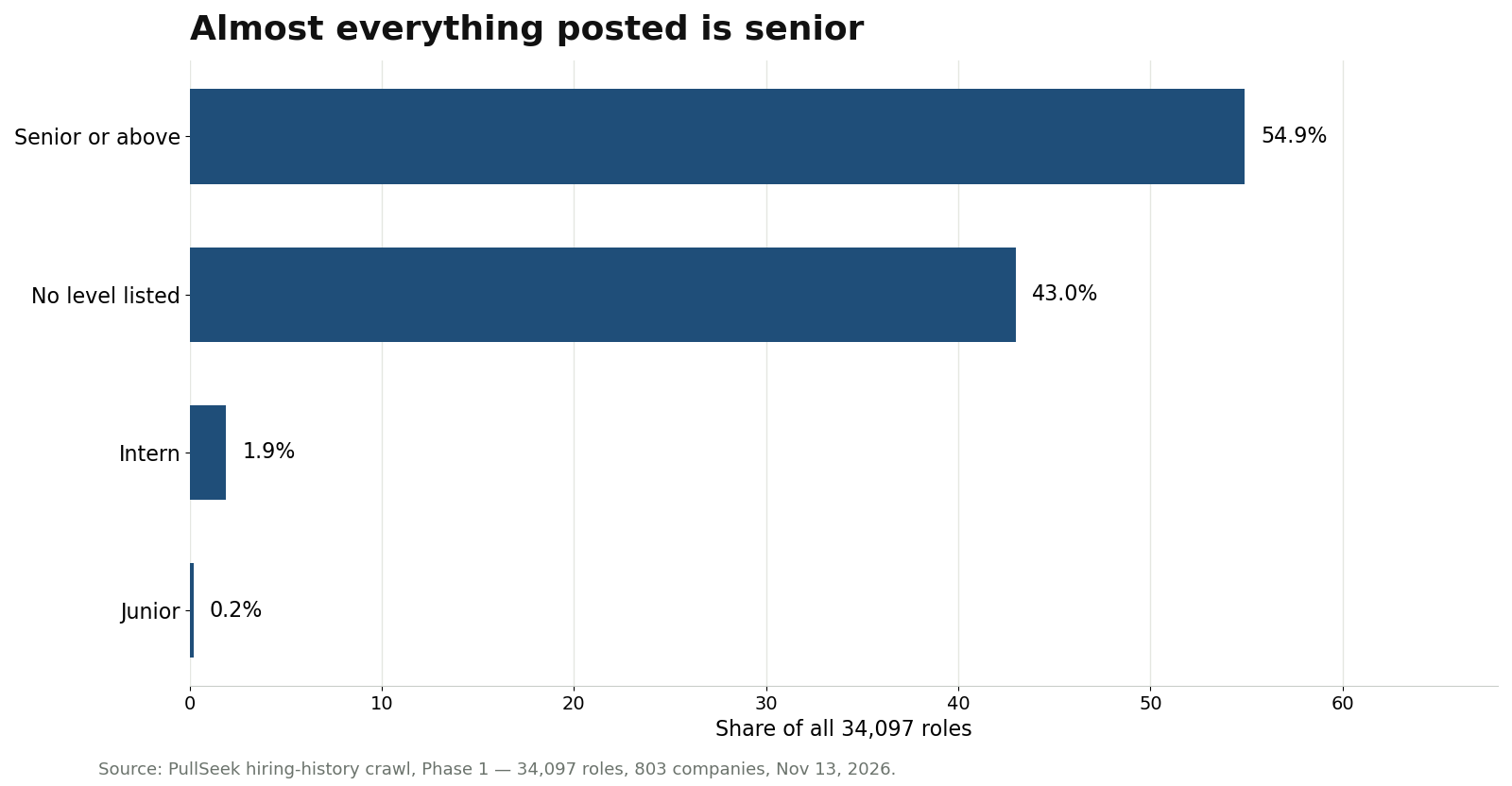
We can see this in our own data. We crawled the public job boards of 803 companies and recorded 34,097 open roles. Of those roles, 54.9% are labelled Senior or above — Senior, Staff, Principal, Lead, Director, or Manager. And 43% of roles carry no level label at all. Among the roles that do state a level, 96.3% are Senior or above.
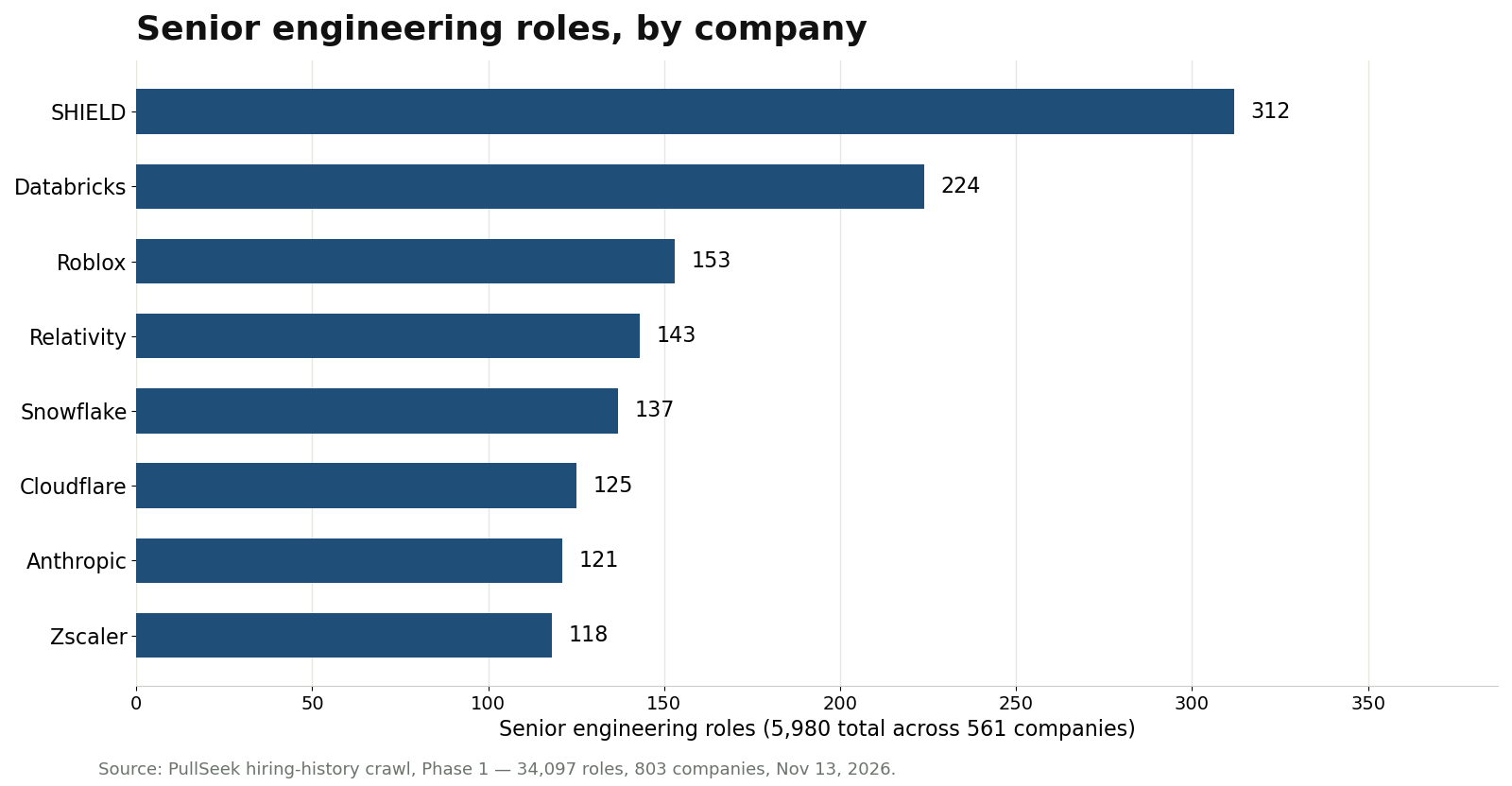
For engineers specifically, the skew is sharper. Of the 10,133 roles with 'engineer' in the title, 5,980 are Senior-level or above — 59.0% of all engineer-titled roles, and 95.9% of the engineer-titled roles that state a level. Those 5,980 senior engineering roles sit across 561 companies. The median company with any senior engineering roles has 4 of them open.
Junior roles barely exist in this file. There are 74 Junior roles in total — 0.2% of all roles — and only 21 of them are engineering roles. Just 44 of the 803 companies have any Junior role open. Internships are not much bigger: 643 roles, under 2%.
This is not a file of companies hiring their first engineers. It is a file of companies hiring their next senior engineers. The junior pipeline that used to feed senior roles is thin to the point of invisible, at least on public boards.
That has a direct consequence for how you reach people. A company posting 4 senior engineering roles is not looking for four applicants. It is looking for four people it can trust with real systems, real on-call, real architectural decisions. Those people are found through trust, not through a form.
Where senior engineers actually are
They are at work. That sounds obvious, and it is the whole problem.
A senior engineer with five years at a good company has no reason to look. Their compensation is competitive. Their team knows them. Leaving means giving up all of that for an unknown. The only thing that moves them is a specific reason: a harder problem, a team they respect, a product they want to build, a leader they want to work for.
They are also visible, if you know where to look. Senior engineers leave traces. They give talks. They write about incidents. They maintain open-source projects. They answer questions in forums. The traces are not a resume. They are evidence of judgment — how someone thinks about a system, how they handle a failure, what they choose to build.
That is the material a good approach is made from. Not their LinkedIn headline. Their work.
There is a second place they are: in other people's heads. Every senior engineer has a short list of people they would work with again, and a short list of people they would recommend. A hiring manager who asks the right three people for names will get further in a day than a posting gets in a month. The referral data backs this up. In Ashby's analysis of more than 38 million applications across 93,000 jobs, from January 2021 to December 2024, 40% of referred candidates reached an interview, against 3% of inbound applicants.
How to approach someone who is not looking
The approach has to respect the fact that you are interrupting a person who is doing fine.
First, be specific. The note has to show you read their work. Name the project, the talk, the post. Say what you noticed about it, in one sentence, in your own words. If the note could be sent to any engineer at any company, delete it and start over. A generic note tells a senior engineer one thing: you did not do the work, so you are asking them to do it for you.
Second, lead with the problem, not the role. Senior engineers do not change jobs for a title. They change for a problem worth solving and a team worth solving it with. Describe the hardest technical problem on your team, plainly, in two sentences. If you cannot describe it plainly, you are not ready to approach anyone.
Third, name the person they would work with. Senior engineers join teams, not companies. The hiring manager's name, the team lead's name, what that person has built. If the person reaching out is not the hiring manager, say who is, and why they want this particular engineer. A recruiter's note that hides the manager reads as a funnel. A note from the manager reads as a decision.
Fourth, make the ask small. Not "are you interested in a role." A conversation. Thirty minutes. A question worth answering. Senior engineers will take a call about an interesting problem. They will not take a call about a job description.
And do not send the same note to fifty people. Mass outreach is how you get ignored by exactly the people you most want to reach. Senior engineers talk to each other. A lazy note sent to five of them becomes a story told to fifty. One careful note, sent to the right person, is worth more than a hundred templated ones.
What not to do
Do not lead with compensation. It is not that money does not matter — it does. But leading with it tells a senior engineer you think they are motivated by money, and that you have nothing else to offer. The problem comes first.
Do not ask for a resume in the first message. They have not applied. You approached them. Asking for a resume reverses the roles and tells them you are running a process, not having a conversation.
Do not set a deadline. "We need to move fast" is your problem, not theirs. A senior engineer who is not looking has no urgency. Urgency in the first message reads as pressure, and pressure reads as a bad team.
What PullSeek does differently
PullSeek exists because finding these people by hand is slow, and doing it well for more than a few engineers at a time is nearly impossible.
We watch 101,498 fast-growing companies, starting with the US. We predict which roles each one is likely to hire in the next 12 months — the role, the level, and the profile that fits. We map the people behind each predicted role: the likely hiring manager, the team lead, the peers. And we draft the introduction to a specific person, which you approve before anything is sent.
For the seeker, the other side of this is the same idea in reverse. We find senior engineers who match a company's predicted roles, and we connect them with the people inside before the job posts — when the conversation is about the work, not about a requisition.
Every prediction is graded. When the window closes, we compare the prediction against the job description the company actually published. That score is the product. If the predictions are wrong, nothing else matters.
You do not need PullSeek to do this. One hiring manager, one careful note, one real problem — that works on its own. PullSeek does it at a scale no person can: every company, every signal, every quarter. The work is the same. The coverage is not.
The bottom line
Senior engineers are not hiding. They are working, in public, leaving evidence of how they think. The companies that hire them are the ones that read the evidence, find the right person, and write a note only that person could receive.
The posting is for people who are looking. The senior engineer you want is not looking. Go to them.
Methodology
Figures in this post were computed from PullSeek's hiring-history crawl, Phase 1 file: 34,097 roles across 803 companies (by domain), fetched November 13, 2026, from public Greenhouse, Ashby, and Lever job boards. Role levels are as listed on the boards; 14,668 rows (43%) carry no level label. Senior engineering roles are roles with 'engineer' in the title and a level of Senior, Staff, Principal, Lead, Director, or Manager: 5,980 roles across 561 companies. Roles with 'engineer' in the title total 10,133; 3,900 of them carry no level label.
The wider hiring-history corpus holds 51,129 deduped role rows across 1,611 companies crawled. The PullSeek company directory holds 101,498 companies. The Inc 5000 database holds 5,003 US high-growth companies.
External figures: Ashby referrals analysis — 40% of referred candidates reached an interview vs 3% of inbound applicants, from 38 million applications across 93,000 jobs, January 2021 to December 2024 (published May 2025).
Related insights
Start with the work, not the posting.
PullSeek predicts the roles companies will hire in the next 12 months and introduces you to the people inside before the job exists. Your first connected role is free.
Get started