How do I stay on a hiring manager's radar for 3–6 months without being pushy?
The short answer: one useful touch every three to four weeks, never an ask, and stop after two unanswered notes.
The short answer: one useful touch every three to four weeks, never an ask, and stop after two unanswered notes.
The relationship that gets you hired is built in the months before the role exists. The hiring manager needs to hear from you rarely enough that each message is worth opening, and specifically enough that each one proves you understand their work. That is the whole method.
Why the window is 3–6 months
Hiring happens in a meeting you are not in, and then it appears all at once.
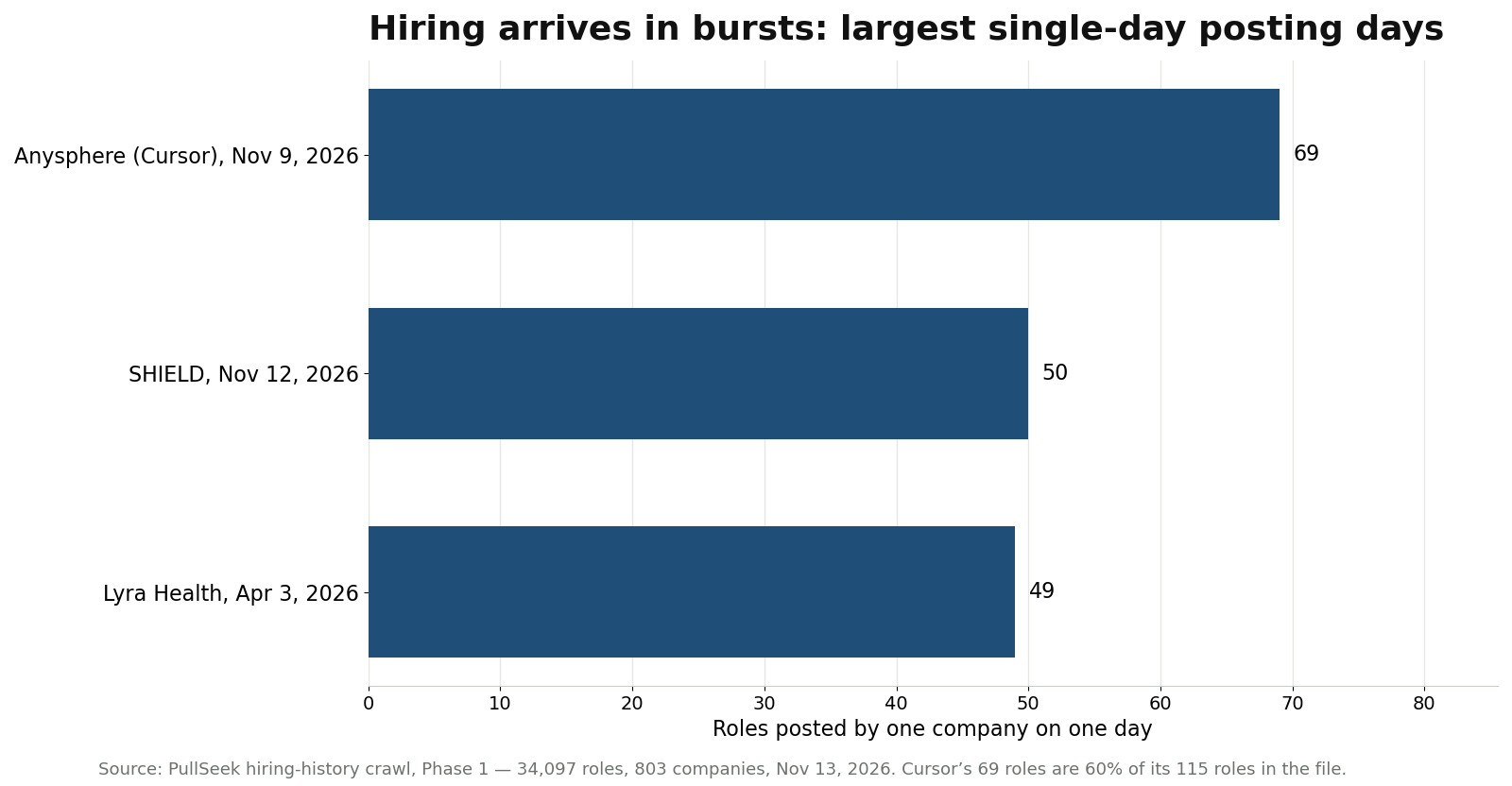
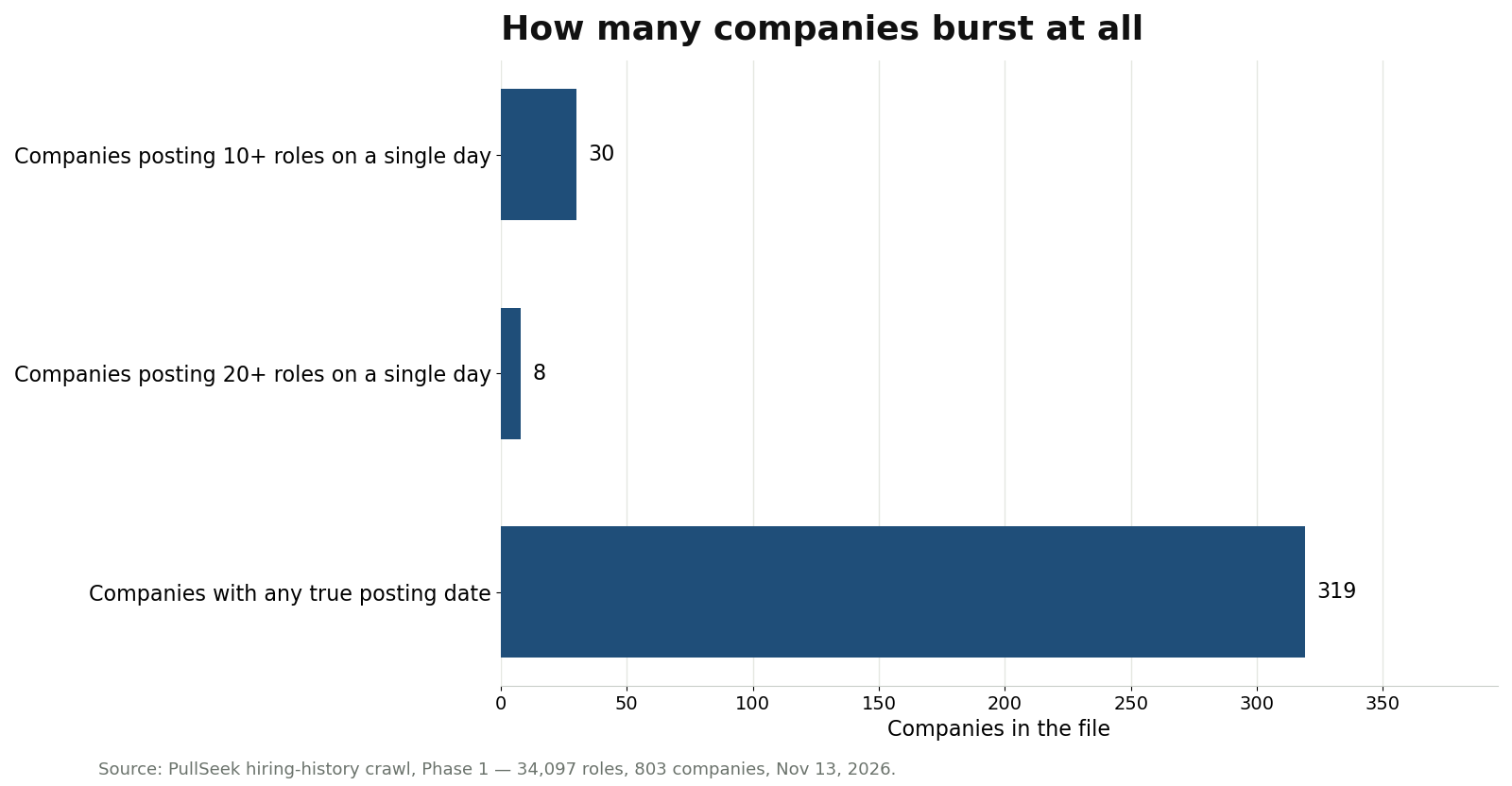
We can see this in our own data: 34,097 open roles across 803 companies. Hiring arrives in bursts, not a steady drip. Cursor — listed as Anysphere (Cursor) — posted 69 roles on a single day, November 9, 2026: 60% of all its roles in our file, posted at once. It is not alone: 30 companies posted 10 or more roles on a single day, and 8 posted 20 or more. SHIELD posted 50 on November 12, 2026; Lyra Health posted 49 on a single day in April 2026.
A 69-role day is not 69 separate decisions. It is one decision, made weeks earlier, executed in an afternoon. The people who knew about it before that afternoon were watching the company — and the company knew them back.
That is why the window is 3–6 months. The decision to hire is made weeks or months before the posting. Meet the hiring manager the week the role posts and you are one of hundreds of applicants. Meet them three months earlier and you are a person they have already talked to. The burst is the deadline. The relationship has to exist before it.
There is a second reason the window matters: you cannot see the posting date coming. Only 40.8% of the roles in our file carry a true posting date at all — Greenhouse, the largest board with 20,170 roles, hides them entirely. You cannot time your outreach to the posting. The only timing you control is when you start the relationship.
The cadence
The cadence that works is slower than you think.
Month 0: the first note. One short, specific message. Not a resume. Not "I'd love to connect." One paragraph: what you noticed about their team's work, what you have built that is relevant, and a question worth answering. If the note could be sent to any company, delete it and start over. Most of the work is in the reading that comes before it.
Weeks 3–4: the first follow-up. Only if the first note earned some response — a reply, a conversation, even a short acknowledgment. It should contain something new: something you shipped, a problem you solved that rhymes with theirs. Not a check-in. A check-in says "I am still here." A useful update says "I am still doing the work."
Then: once every three to four weeks. Four to six touches across the whole window, including the first note. Each one short, about their work or yours, never about a job. The goal is not to be remembered as persistent. It is to be remembered as competent, when the role appears.
When the role posts: one message, the same day. You saw the role, you have been following the team's work, here is the one thing you have built that is most relevant. This is the only message in the sequence that mentions a job, and it only works because the previous four did not.
What counts as useful
Useful has a narrow definition: the hiring manager learns something from it, or it proves — concretely — that you can do the work. Everything else is noise.
Useful looks like this: a short note on a talk they gave, pointing at the one decision you found interesting. A link to something you shipped that solves a problem like theirs. A question about a real technical choice their team made in public.
Pushy looks like this: "Just checking in" with nothing attached. A resume sent unasked. A message that asks for a call in the first line. Flattery with no specific content. A follow-up three days after the first note. A message on every channel at once.
The test is simple: if you deleted your name from the message, would it still be worth reading? If yes, send it. If no, do not.
One more rule: never attach a resume unless asked. A resume in an unsolicited note says you are applying for a job that does not exist. A short note with a link to one thing you built says you are a peer who does the work. Let them ask for the resume.
When to go quiet
Knowing when to stop transmitting is part of the method.
Two unanswered notes, then stop. If you sent a good first note and one good follow-up and heard nothing, do not send a third. Silence is an answer. A third note does not change their mind. It changes their opinion of you.
After a "not now," wait a quarter. If they replied politely but the timing is wrong — no headcount, a freeze, a reorg — thank them, and go quiet for three months. Then one short note, with something new in it. A polite no now is a no for this quarter. The quarter is the unit.
When the role posts and you are not the pick, stop. One message when the role posts, as above. If they hire someone else, congratulate them briefly if you mean it, and move on.
Never go public. You are employed. Do not post "open to work." A direct note to one person is invisible to your employer and far more effective than a signal to everyone.
Keep the list short. Ten companies, not a hundred — companies whose product you understand and whose engineering problems you can talk about without a script. If you cannot name the team's hardest problem, you are too early to reach out. Ten companies, three people each, one good note each. A hundred companies is a spreadsheet you will abandon in three weeks.
What PullSeek does differently
PullSeek exists because this process is hard to do by hand for more than a few companies — and the timing is the hard part.
We watch 101,498 fast-growing companies, starting with the US. We predict which roles each one is likely to hire in the next 12 months — the role, the level, and the profile that fits — and map the people behind each predicted role. We draft the introduction to a specific person, which you approve before anything is sent.
The cadence is the product. Our hiring-manager introductions run every 3–6 months — the same window this post describes — because that is how long the relationship needs before the burst. A job board tells you what is open now. We tell you what is likely to open next.
You do not need PullSeek to do this. Ten companies, three people each, one good note every three to four weeks — that works on its own. PullSeek does it at a scale no person can: every company, every signal, every quarter.
The bottom line
The hiring manager will not remember the person who applied fastest. They will remember the person they have been talking to for four months, who sent five short messages, each one worth reading.
Start three to six months before the role exists. Write once every three to four weeks. Say something useful, never ask for a job that does not exist, and go quiet when silence tells you to.
That is the whole method. It is slow, and it is the only part of hiring you actually control.
Methodology
Figures in this post were computed from PullSeek's hiring-history crawl, Phase 1 file: 34,097 roles across 803 companies (by domain), fetched November 13, 2026, from public Greenhouse, Ashby, and Lever job boards. Burst figures count roles sharing one company and one posting date: Cursor (listed as "Anysphere (Cursor)") posted 69 roles on November 9, 2026, of 115 total (60%); 30 companies posted 10 or more roles on a single day; 8 posted 20 or more. SHIELD posted 50 on November 12, 2026; Lyra Health posted 49 on a single day in April 2026. Only 13,927 roles (40.8%) carry a true posting date; Greenhouse publishes none, which is why 59.2% of roles have none. Role levels are as listed on the boards; 14,668 rows (43%) carry no level label.
The wider hiring-history corpus holds 51,129 deduped role rows across 1,611 companies crawled. The PullSeek company directory holds 101,498 companies. The Inc 5000 database holds 5,003 US high-growth companies.
Cadence recommendations are practical guidance, not measurements from the file. The file records roles and posting dates, not outreach outcomes.
Related insights
Start the relationship before the burst.
PullSeek predicts the roles companies will hire in the next 12 months and introduces you to the people inside before the job exists. Your first connected role is free.
Get started