How can I tell if a company is about to start hiring engineers?
The short answer: watch for bursts, leaders, and clusters. Hiring does not arrive one role at a time. It arrives all at once, after a decision you could have seen coming.
The short answer: watch for bursts, leaders, and clusters. Hiring does not arrive one role at a time. It arrives all at once, after a decision you could have seen coming.
A company does not wake up and post one engineering role, then another the next week, then another the week after. That is not how teams are built. A team decides it needs five engineers, gets the budget approved, and posts five roles in a day. The posting is the execution. The decision happened weeks earlier, and it leaves traces.
If you watch for the traces, you can be talking to the team before the roles exist. If you wait for the posting, you are one of hundreds.
Hiring arrives in bursts
We can see this in our own data. We crawled the public job boards of 803 companies and recorded 34,097 open roles. The median company in our file has 15 roles open. But the roles do not appear evenly.
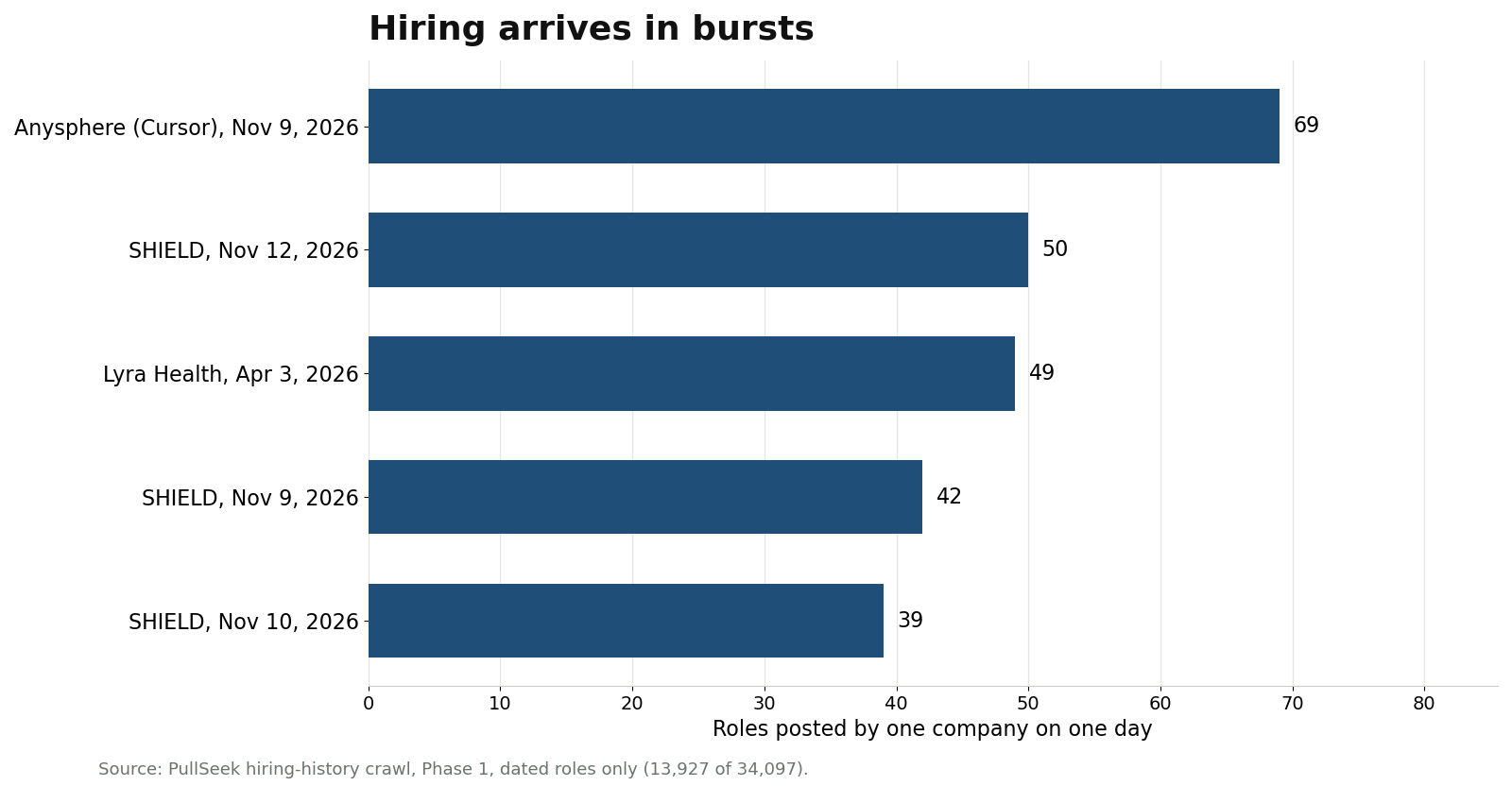
One company, Anysphere (Cursor), posted 69 roles on a single day — November 9, 2026. That is 60% of all its roles in our file, posted at once. Sixteen of the 69 are engineering roles; 44 carry no level label.
Cursor is not the exception. In our file there are 110 company-days where a single company posted 10 or more roles in one day, and 22 where it posted 20 or more. SHIELD posted 50 roles on November 12, 2026, and 42 more on November 9. Lyra Health posted 49 roles on April 3, 2026. Pennylane posted 34 roles on October 20, 2026, and 32 on September 18.
A 69-role day is not 69 separate decisions. It is one decision, made weeks earlier, executed in an afternoon. The same is true of a 10-role day, or a 5-role day. The burst is the visible part. The decision is the part that matters, and it happened before the burst.
One caution. Only 40.8% of the roles in our file carry a true posting date at all. Greenhouse, the largest board in the file with 20,170 roles, hides posting dates entirely. So bursts are only visible where the board publishes dates — Ashby and Lever. A company on Greenhouse can burst just as hard, and you will not see the date. You will only see the count jump. The count is enough.
A new leader is a hiring plan with a name on it
The second signal is a leadership hire. Leaders build teams. When a senior leader joins, the roles under them follow.
Our file holds 1,630 roles at Director level or above — Director, VP, or Executive — spread across 408 companies (by domain). That is half the companies in the file with at least one senior leadership role open. These are not backfills. A company opening a Director of Engineering role, or a VP of Engineering role, is building something, and the engineers come after the leader.
The pattern is worth watching in both directions. A company that has just hired a new VP of Engineering is about to hire the engineers that person wants. A company that is currently hiring a VP of Engineering will hire those engineers a few months later, once the leader is in place. Either way, the leadership role is the early warning.
Find the leader early. Read what they have built before. Write to them about the work, not about a job that does not exist yet. The leader is the person who will decide whether you are in the room when the roles open.
Role clusters: the shape of a team being built
The third signal is a cluster — several roles appearing together that describe a team, not a single vacancy.
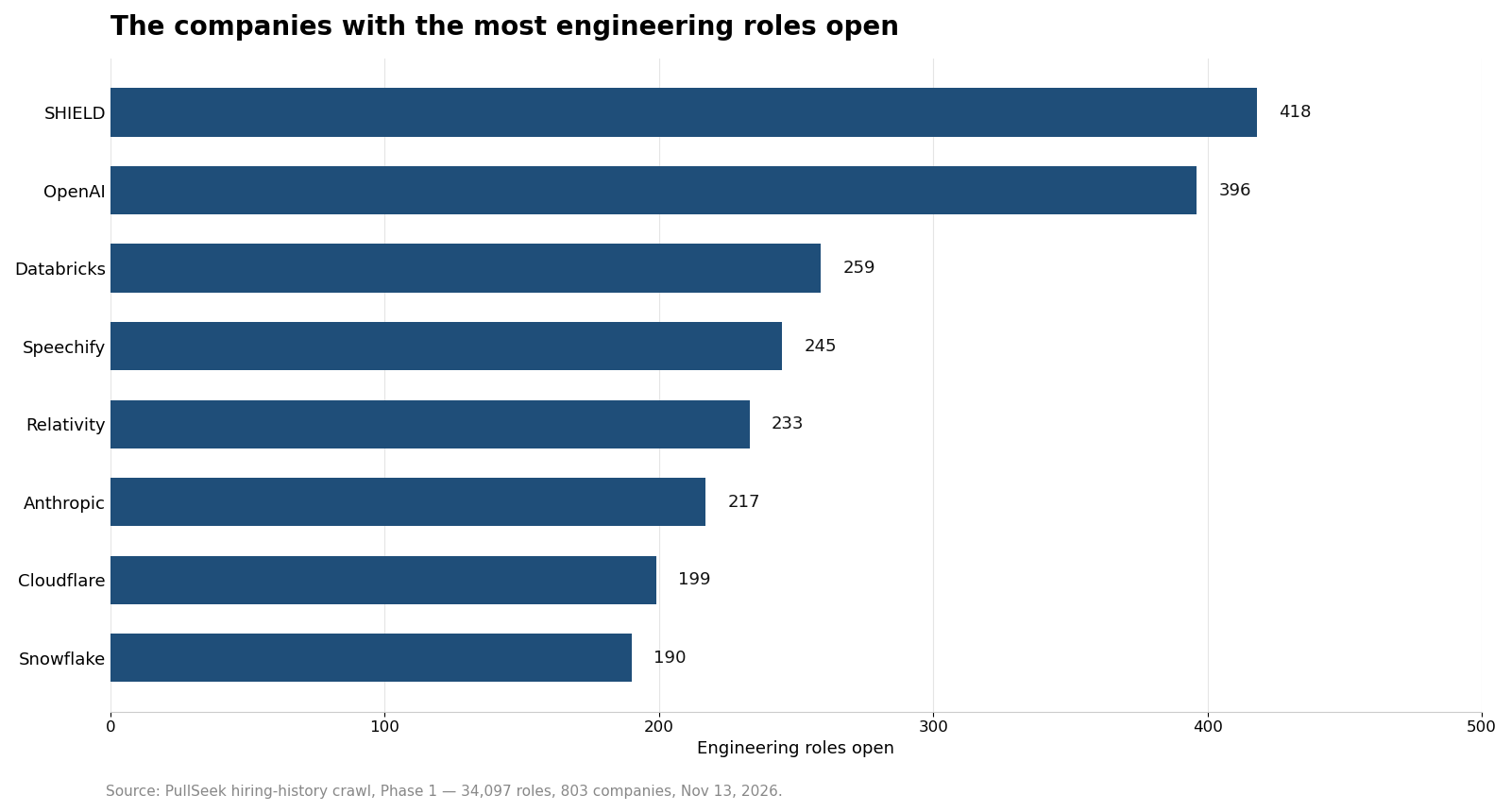
Engineering is 29.7% of all roles in our file — 10,133 of 34,097. The companies with the most engineering roles open are the ones building the biggest teams: SHIELD with 418 engineering roles, OpenAI with 396, Databricks with 259, Speechify with 245, Anthropic with 217.
But the cluster signal is not about the biggest companies. It is about the shape. When a company posts a backend engineer, a frontend engineer, a DevOps engineer, and a data engineer in the same week, that is not four coincidences. That is a team being stood up. When a company posts a Staff engineer and two Senior engineers together, that is a senior team being built, with a lead already in mind.
In our file, there are 88 company-days where a single company posted 5 or more engineering roles in one day, and 20 where it posted 10 or more. Those are team-building days. Each one is a company that made a decision weeks earlier and is now executing it in public.
What to watch, in order
You cannot watch every company. You can watch a short list, on a rhythm, for three things.
1. The count. Pick ten companies whose product you understand. Check their career pages weekly. Note the number of open roles. A jump of five or more in a week is a decision. A jump of ten or more is a big one. The count is the cheapest signal there is, and it works even when the board hides posting dates.
2. The leader. Watch for a new VP of Engineering, Head of Engineering, or Director of Engineering — announced on LinkedIn, in a press release, or as an open role on the board. A new leader means hiring is coming. Reach out to the leader within weeks of the announcement, about the work, not the job.
3. The cluster. When roles appear, read them as a group. Three or more engineering roles in the same week, especially at Senior level or above, means a team is being built. Note what the team is for. That is what your note should be about.
And one more, from outside our data: money. A funding round is the most public signal there is. A company that raises money hires. We have not yet measured the exact lag between a funding round and the first senior hire — our hiring-history file records roles and posting dates, not funding dates — so treat funding as direction, not a timetable. Watch the announcement, then watch the career page over the following quarter.
What PullSeek does differently
PullSeek exists because watching companies by hand, on a rhythm, for more than a few companies at a time, is work nobody sustains.
We watch 101,498 fast-growing companies, starting with the US. We predict which roles each one is likely to hire in the next 12 months — the role, the level, and the profile that fits. We map the people behind each predicted role: the likely hiring manager, the team lead, the peers. And we draft the introduction to a specific person, which you approve before anything is sent.
The prediction is the point. A job board tells you what is open now. We tell you what is likely to open next, so the relationship starts before the posting — when it still matters.
You do not need PullSeek to do this. Ten companies, a weekly check, one good note — that works on its own. PullSeek does it at a scale no person can: every company, every signal, every quarter. The work is the same. The coverage is not.
The bottom line
Companies do not hire one person at a time. They decide, then they post in a batch. The batch is visible. The decision is not — unless you were watching before it.
Watch the count, watch the leader, watch the cluster. Then write to one person, about the work, before the role exists.
Methodology
Figures in this post were computed from PullSeek's hiring-history crawl, Phase 1 file: 34,097 roles across 803 companies (by domain), fetched November 13, 2026, from public Greenhouse, Ashby, and Lever job boards. Role levels are as listed on the boards; 14,668 rows (43%) carry no level label. Posting dates are true dates only where the board publishes them (Ashby and Lever); Greenhouse publishes no posting dates, which is why 59.2% of roles in the file have none. Burst counts are computed only on the 13,927 dated roles. Company counts are by domain throughout. An engineering role is one whose title contains 'engineer': 10,133 roles. Senior engineering roles are engineer-titled roles at Senior, Staff, Principal, Lead, Director, or Manager level: 5,980 roles across 561 companies (by domain).
The wider hiring-history corpus holds 51,129 deduped role rows across 1,611 companies crawled. The PullSeek company directory holds 101,498 companies. The Inc 5000 database holds 5,003 US high-growth companies.
Related insights
See the burst before it happens.
PullSeek predicts the roles companies will hire in the next 12 months and introduces you to the people inside before the job exists. Your first connected role is free.
Get started