Which roles will we need to hire in the next 6–12 months?
The short answer: look at what companies like yours are hiring right now, in what order, and in what combinations. Your next hires are probably the roles that cluster with the ones you already have.
The short answer: look at what companies like yours are hiring right now, in what order, and in what combinations. Your next hires are probably the roles that cluster with the ones you already have.
Founders usually answer this question from the inside. They look at the roadmap, the backlog, the team that is stretched thinnest, and they guess. That guess is often right about the next hire and wrong about the three after it. The pattern of hiring at similar companies is a better guide than the roadmap alone, because the roadmap says what you plan to build. The hiring pattern says what companies actually need when they build it.
Hiring arrives in clusters, not one role at a time
We crawled the public job boards of 803 companies and recorded 34,097 open roles. The median company has 15 roles open. But the roles are not spread evenly across functions. They cluster.
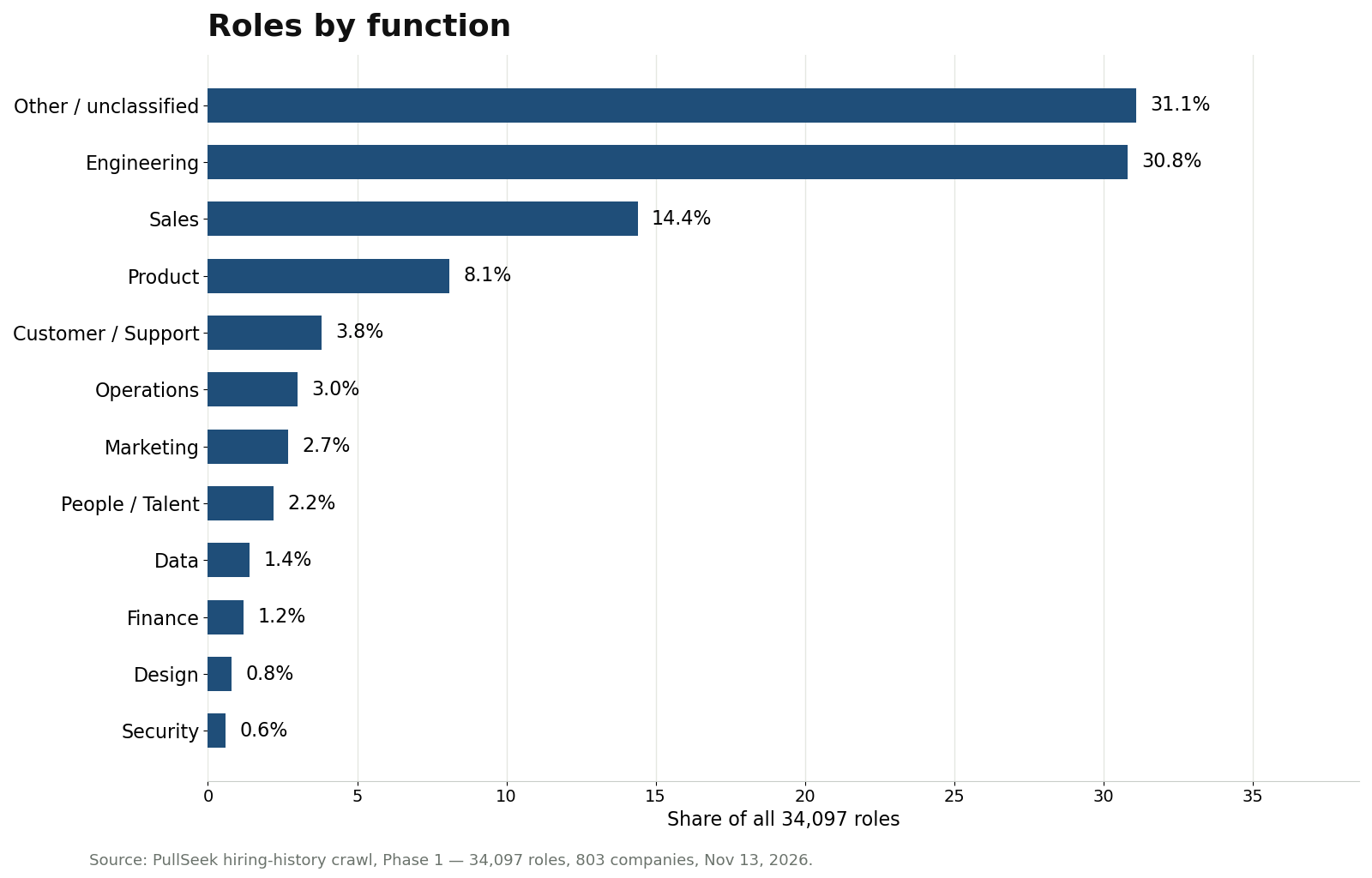
Engineering is the largest single function: 10,499 roles, or 30.8% of everything in the file. Sales is next at 4,920 roles (14.4%), then Product at 2,748 (8.1%). Customer and support roles account for 1,294. Operations 1,013. Marketing 919. People and talent 736. Data roles — data scientists, analysts, analytics engineers grouped by title — 481.
The interesting part is not the ranking. It is which roles appear together at the same company.
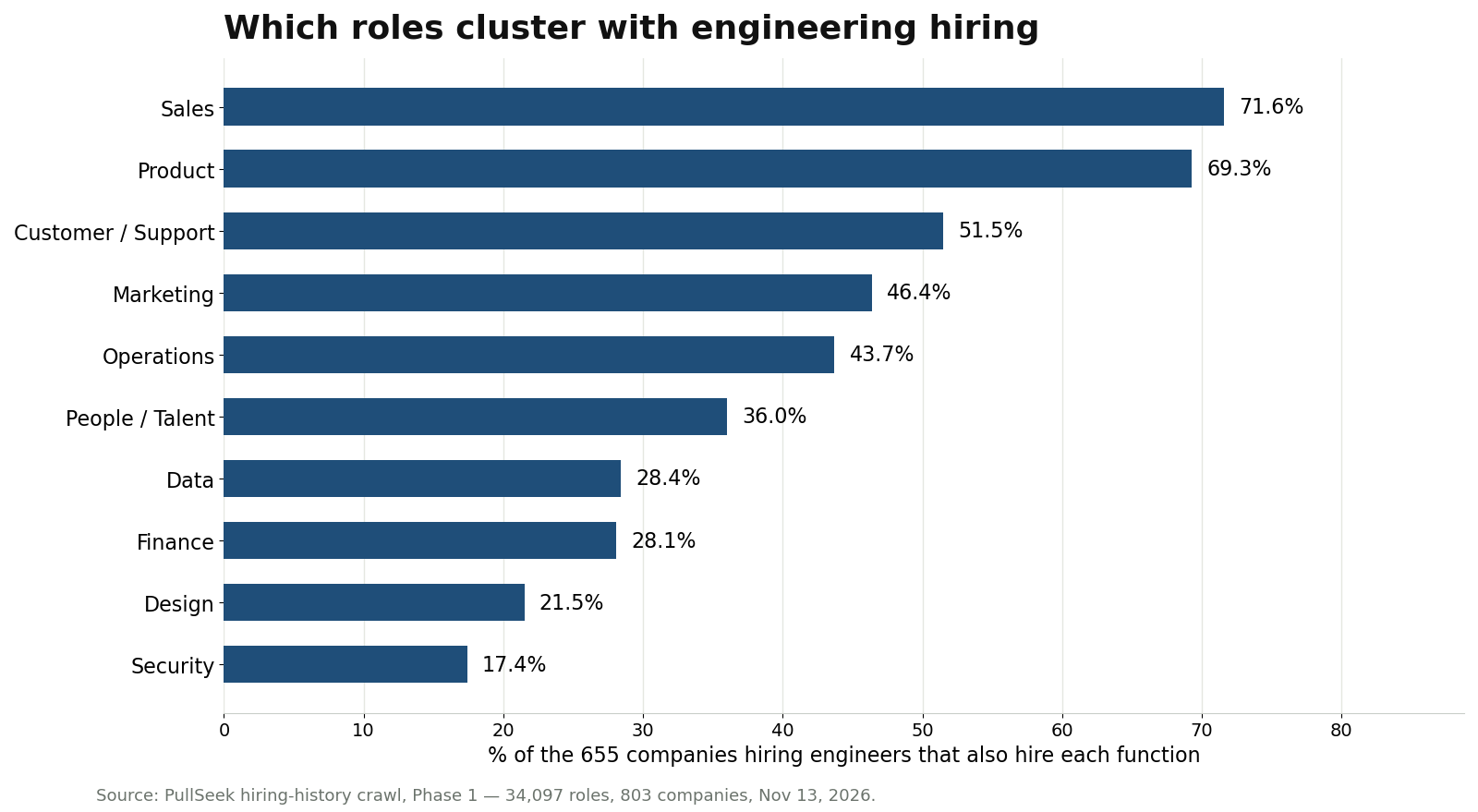
Of the 655 companies hiring engineers, 469 are also hiring sales roles (71.6%) and 454 are also hiring product roles (69.3%). More than half are also hiring customer and support roles (51.5%). Marketing shows up at 46.4% of engineering-hiring companies. Operations at 43.7%. People and talent at 36.0%.
In other words, a company hiring engineers is usually hiring across the whole go-to-market and support surface at the same time. Engineering plus sales plus product is the default shape of a growing company, not the exception. 357 companies — 45.5% of all companies in the file — have engineering, sales, and product roles open simultaneously.
Only 23 companies are hiring engineering roles and nothing else.
That matters for a founder planning the next year. If you are hiring your fifth engineer and have no product or sales roles open, you are either earlier than the typical pattern or you are about to feel the gap. The companies in our file that look like yours, one stage ahead, have already filled those seats. The cluster is the plan.
The senior mix tells you what stage the hire is for
The second pattern is the seniority mix. Of the 19,429 roles in our file that carry a level label, 96.3% are Senior or above — Senior, Staff, Principal, Lead, Director, or Manager. That number is high partly because many junior roles are never labelled, and 43% of roles carry no level at all. But the direction is clear across every function: engineering roles with a label are 96.1% Senior or above; product 97.9%; sales 97.8%; data 94.8%.
Only 717 roles in the entire file are labelled Intern or Junior. That is 3.7% of labelled roles.
A founder reading this should take two things from it. First, the open market at growing companies is overwhelmingly a senior market. If your next hire is a senior engineer, you are competing with nearly every company in the file. Second, junior hiring barely shows up on public boards at all.
Leadership hiring is the other signal worth watching. 6,549 roles in the file — 19.2% of all roles — are labelled Manager, Director, VP, or Executive. 633 companies, or 80.7% of the file, have at least one Manager-level role or above open. A company hiring managers is building the layer that will hire the next twenty people. When a competitor posts a Director of Engineering role, the engineers under that director are usually 6 to 12 months behind it.
Hiring arrives in bursts
The third pattern is timing. Hiring does not arrive as a steady drip. It arrives in bursts.
There are 110 company-days in the file where a single company posted 10 or more roles on one day. The largest: Anysphere, the company behind Cursor, posted 69 roles on November 9, 2026. SHIELD posted 50 roles on November 12, 2026. Lyra Health posted 49 roles on April 3, 2026.
A 69-role day is not 69 separate decisions. It is one decision, made weeks earlier, executed in an afternoon. The budget was approved, the plan was written, and then the postings went up together.
For a founder, the practical read is this: your own hiring will probably work the same way. You will not hire one person a month for a year. You will decide to grow a team, approve the budget, and open eight roles in a week. Planning for that burst — the interview load, the onboarding load, the manager time — matters more than planning for the average. The average hides the burst. The burst is the reality.
How to use this for your own plan
Start with the cluster, not the single role.
Write down the roles you have open now. Then write down the roles that companies at your stage, in your category, have open alongside them. If engineering plus product plus sales is the cluster and you have only engineering, the next hire is probably a product manager or an account executive, not a sixth engineer. The data does not prove that for your company specifically. It shows what the companies that survived to your stage did next.
Next, look at the senior mix of the cluster. If the roles around yours are mostly Senior and Manager, the market you are hiring into is expensive and slow. Budget for a search measured in months, not weeks, and for a referral-led search rather than a posting. Senior roles in this file are the ones least likely to be filled from a cold application, because the hiring manager usually already has a name in mind before the req opens.
One honest note: this file shows what is open now. It does not show the order in which roles were opened, or how long each one stayed open. We have not yet measured the sequence — whether product managers come before or after the sales hire, for example. We are working on the sequence now, and we will publish it when we can defend it. Until then, treat the cluster as a map of what goes together, not a timetable of what comes first.
What PullSeek does differently
PullSeek watches 101,498 fast-growing companies and predicts which roles each one is likely to hire in the next 12 months — the role, the level, and the profile that fits. For a founder, that means the prediction runs in both directions: which roles your company is likely to need, and which candidates are already in the market for them before the req is written.
A job board tells you what is open now. We tell you what is likely to open next, so the relationship with the candidate starts before the posting — when it still matters.
Every prediction is graded. When the window closes, we compare the prediction against the job description the company actually published. That score is the product. If the predictions are wrong, nothing else matters.
The bottom line
Your next hires are probably not a mystery. They are the roles that cluster with the ones you already have: engineering with product and sales, support and operations close behind, and a manager layer that arrives before the team it will manage.
Look at the cluster. Hire for the burst. And start the search before the req exists, because by the time it is posted, the companies you compete with have already started theirs.
Methodology
Figures in this post were computed from PullSeek's hiring-history crawl, Phase 1 file: 34,097 roles across 803 companies (by domain), fetched November 13, 2026, from public Greenhouse, Ashby, and Lever job boards. Role families were grouped by keywords in the role title (for example, titles containing "engineer", "developer", or "software" were counted as Engineering; titles containing "sales" or "account executive" as Sales). 6,209 roles (18.2%) did not match any family keyword and are counted as Other. Role levels are as listed on the boards; 14,668 rows (43%) carry no level label. "Senior or above" means Senior, Staff, Principal, Lead, Director, Manager, VP, or Executive.
The wider hiring-history corpus holds 51,129 deduped role rows across 1,611 companies crawled. The PullSeek company directory holds 101,498 companies. The Inc 5000 database holds 5,003 US high-growth companies.
Related insights
Know your next hires before the req exists.
PullSeek predicts the roles companies will hire in the next 12 months — the role, the level, and the profile that fits — and finds the candidates already in the market for them. Your first connected role is free.
Get started