Is a 20% recruiter fee or a flat subscription cheaper for 5–10 senior hires a year?
The short answer: for 5–10 senior hires a year, the 20% fee is usually several times the subscription. One hire's fee alone costs more than a year of PullSeek.
The short answer: for 5–10 senior hires a year, the 20% fee is usually several times the subscription. One hire's fee alone costs more than a year of PullSeek.
This is arithmetic, not opinion. A fee scales with every hire; a subscription does not. At five to ten hires a year, the per-hire fee compounds into a number that dwarfs the flat price. The assumptions are labelled so you can redo the working with your own numbers.
The arithmetic, with assumptions labelled
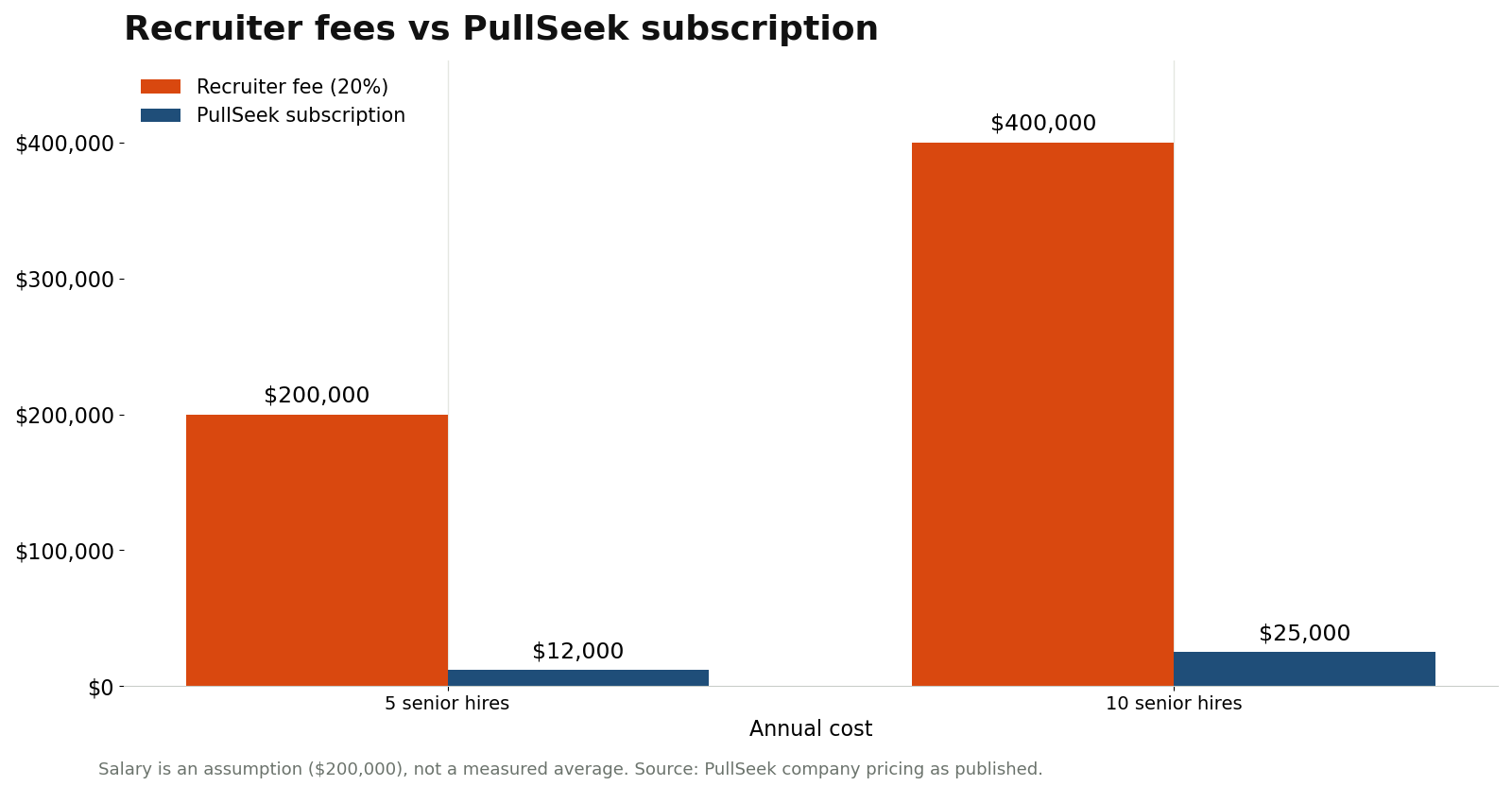
Take the premise: a recruiter charging 20% of first-year salary per hire. Assume a senior salary of $200,000 — an assumption, not a fact; our file has no compensation data. At that assumption, 20% is $40,000 per hire. Five hires cost $200,000; ten cost $400,000.
Now the subscription. PullSeek's company pricing is public: $12,000 a year for up to 20 potential roles, $25,000 a year for up to 100, and $50,000 a year flat beyond 100.
Five hires against the $12,000 tier: $200,000 in fees against $12,000. Ten hires against the $25,000 tier: $400,000 against $25,000. Even the top tier — $50,000 a year, flat, beyond 100 potential roles — is an eighth of the recruiter's bill for ten hires.
Try a lower salary assumption and the answer does not change. Assume $100,000 instead. Then 20% is $20,000 per hire, and five hires cost $100,000 in fees — still more than eight times the $12,000 tier. One hire's fee at the lower assumption is already more than a full year of the $12,000 subscription.
The break-even point is below one hire. At the $200,000 assumption, a single placement's $40,000 fee is 3.3 times the $12,000 annual subscription; at the $100,000 assumption, a single placement's $20,000 fee is 1.7 times it. You do not need five hires for the subscription to be cheaper. You need one.
Is 5–10 senior hires a real scale?
A worked example is only useful if the scale matches how companies actually hire. Ours does.
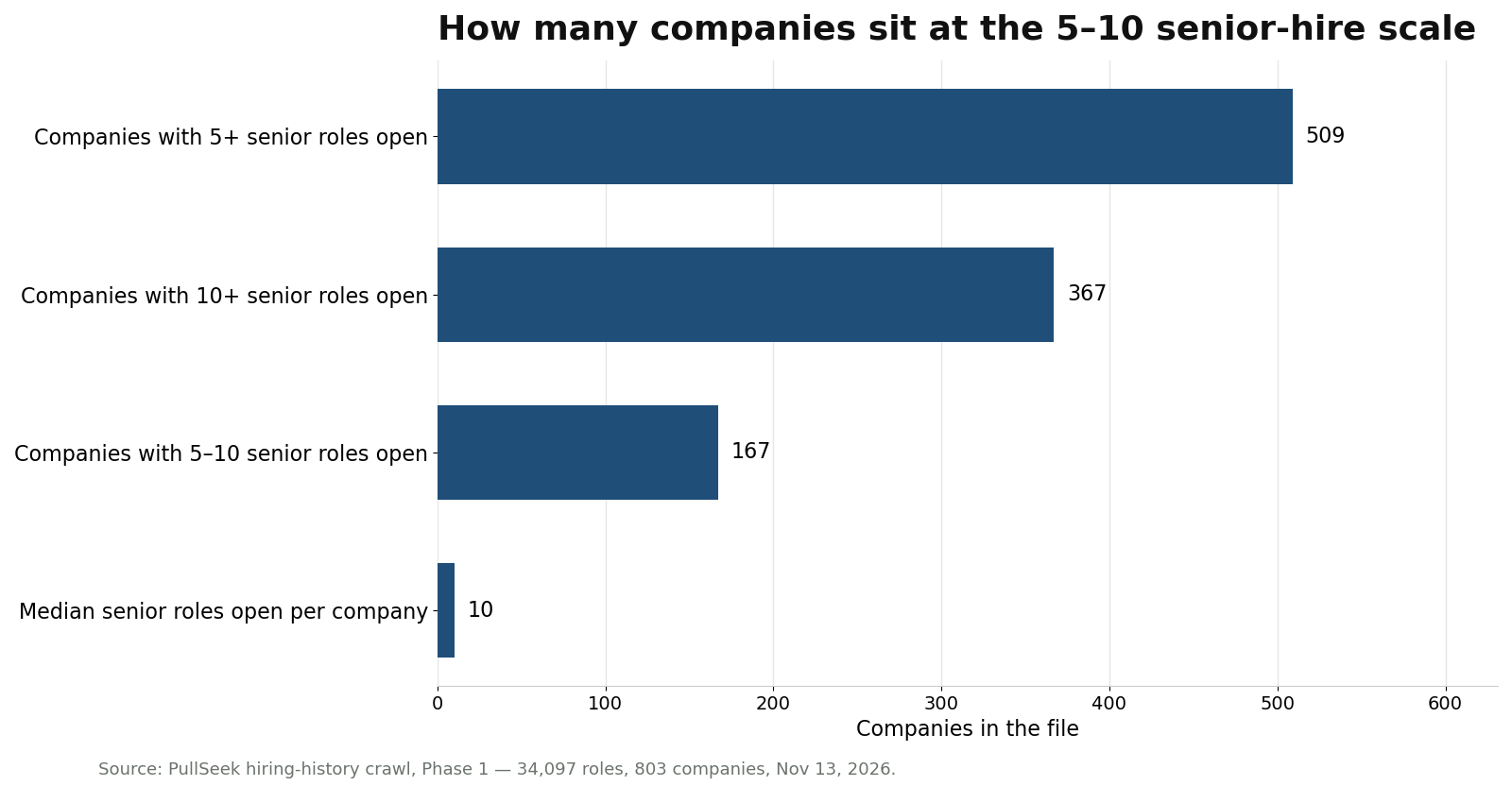
In our hiring-history file, the median company has 15 roles open, and 10 of them are senior — Senior, Staff, Principal, Lead, Director, or Manager. That is the current open req load, not the annual hiring plan, but it sets the scale: a company with 10 senior roles open will make several senior hires in a year, not one.
More precisely: 725 of the 784 companies in the file — 92.5% — have at least one senior role open right now. 509 have five or more, 367 have ten or more, and 167 sit exactly in the 5–10 band. The "5–10 senior hires a year" in the title is not a hypothetical. It is where a large middle of growing companies lives.
The point is not that every company hires 5–10 seniors a year. It is that the companies for whom this comparison matters — the ones hiring senior people repeatedly — are common, not rare. If you hire one senior person a year, the fee versus subscription question is a rounding error. If you hire five or more, the fee is the largest line in your hiring budget.
What the fee buys that the subscription does not — and vice versa
The arithmetic answers the price question, not the value question.
A recruiter's fee buys work done for you: sourcing, screening, chasing. You pay per placement, nothing if nobody is placed — and the recruiter only gets paid when someone starts.
What the fee does not buy is timing. A recruiter works a req that already exists. By the time a senior role reaches a recruiter, it has been defined, approved, and usually posted — and the best candidates are the people the hiring manager already knows. The recruiter is searching a market that has already seen the role. That is late for a senior hire.
A subscription buys the opposite: coverage before the req exists. PullSeek predicts the roles a company is likely to hire in the next 12 months and maps the people behind each predicted role, so the introduction happens before the posting. You pay for the year, whether you hire five people or fifteen.
What the subscription does not buy is the work of closing. PullSeek does not interview candidates, negotiate offers, or replace your hiring manager's judgment. It puts the right introduction in front of you before the role is public. The hire is still yours to make.
So the honest comparison is not "fee versus subscription" as if they were the same thing at different prices. The fee buys execution on a req you already have. The subscription buys the relationship before the req exists — the scarce part of a senior hire, since senior roles go to people the team already knows or someone trusted vouches for. The fee cannot buy that retroactively.
When the fee wins
The subscription is not always the right answer. Say so plainly.
If you hire one senior person a year and the role is unusual — a very specific domain, a rare skill combination — a good recruiter who knows that niche is worth the fee. One $40,000 placement under the stated assumption is a single expense for a single hard problem, and the recruiter's network may be the only way in.
If you have no internal recruiting capacity at all and no one on the team has time to talk to candidates before a req opens, a subscription that produces introductions will not help you — the introductions will sit unread. The fee at least buys someone doing the work.
But notice what these cases have in common: low volume, unusual roles, or no capacity to use a pipeline. None of them is the 5–10 hires a year in the title. At that volume, you are hiring constantly — and the fee is a tax on every hire you make.
There is one more cost, in neither price: the senior seat sitting empty. A search that starts at posting time costs the work the team did not ship — and the fee, by construction, starts after the decision.
What PullSeek does differently
PullSeek predicts the roles companies will hire in the next 12 months — the role, the level, and the profile that fits — and connects the hiring team with the people inside before the job posts.
For a hiring manager, the point is not only that the subscription is cheaper — at 5–10 senior hires a year it is, by a wide margin. It is that the subscription buys the part of hiring a fee cannot: the months before the req exists, when the relationship is formed and the candidate is already known. Every prediction is graded against the job description the company actually publishes.
You do not need PullSeek to do this math — it is arithmetic you can do on a napkin. PullSeek is for the part after the math: knowing which roles are coming, and who to talk to before they post.
The bottom line
At 5–10 senior hires a year, a 20% fee is not a little more expensive than a flat subscription. At the stated assumptions it is roughly eight to sixteen times more — $200,000 to $400,000 against $12,000 to $25,000.
The fee buys execution on a req you already have. The subscription buys the relationship before the req exists — the scarce part of senior hiring. Pay for that.
Methodology
Figures in this post were computed from PullSeek's hiring-history crawl, Phase 1 file: 34,097 roles across 803 companies (by domain), fetched November 13, 2026, from public Greenhouse, Ashby, and Lever job boards. "Senior" means Senior, Staff, Principal, Lead, Director, or Manager, the same definition as post #1. Role levels are as listed on the boards; 14,668 rows (43%) carry no level label. Median roles per company is 15; median senior roles per company is 10 among the 725 companies with at least one senior role open (9 including the 59 with none). 509 companies have five or more senior roles open; 367 have ten or more; 167 have between five and ten.
PullSeek company pricing is as published: $12,000 a year for up to 20 potential roles, $25,000 a year for up to 100, and $50,000 a year flat beyond 100. Salary figures ($200,000 and $100,000) are assumptions for the worked example — the file contains no compensation data, and no average senior salary is claimed.
The wider hiring-history corpus holds 51,129 deduped role rows across 1,611 companies crawled. The PullSeek company directory holds 101,498 companies. The Inc 5000 database holds 5,003 US high-growth companies.
No external fee survey or salary data was used. The 20% fee is the premise in the title, treated as a given to work through, not a market average we verified.
Related insights
Pay for the relationship, not the fee.
PullSeek predicts the roles your company will hire in the next 12 months and connects you with the people inside before the job posts — for a flat subscription, not a fee on every hire. Your first connected role is free.
Get started