How do we stop AI-generated applications from burying the real candidates?
The short answer: stop reading applications first. Start with a small set of people you already have a reason to talk to, and let the application be the last step, not the first.
The short answer: stop reading applications first. Start with a small set of people you already have a reason to talk to, and let the application be the last step, not the first.
AI made applying free. A candidate can now generate a tailored resume and cover letter for a hundred jobs in an afternoon, at no cost. The result is not better applications. It is more applications — far more — and the hiring manager pays for it, in hours spent reading words nobody wrote and nobody means.
The volume problem is real, and it is getting worse. The fix is not a better filter. It is a different order of operations.
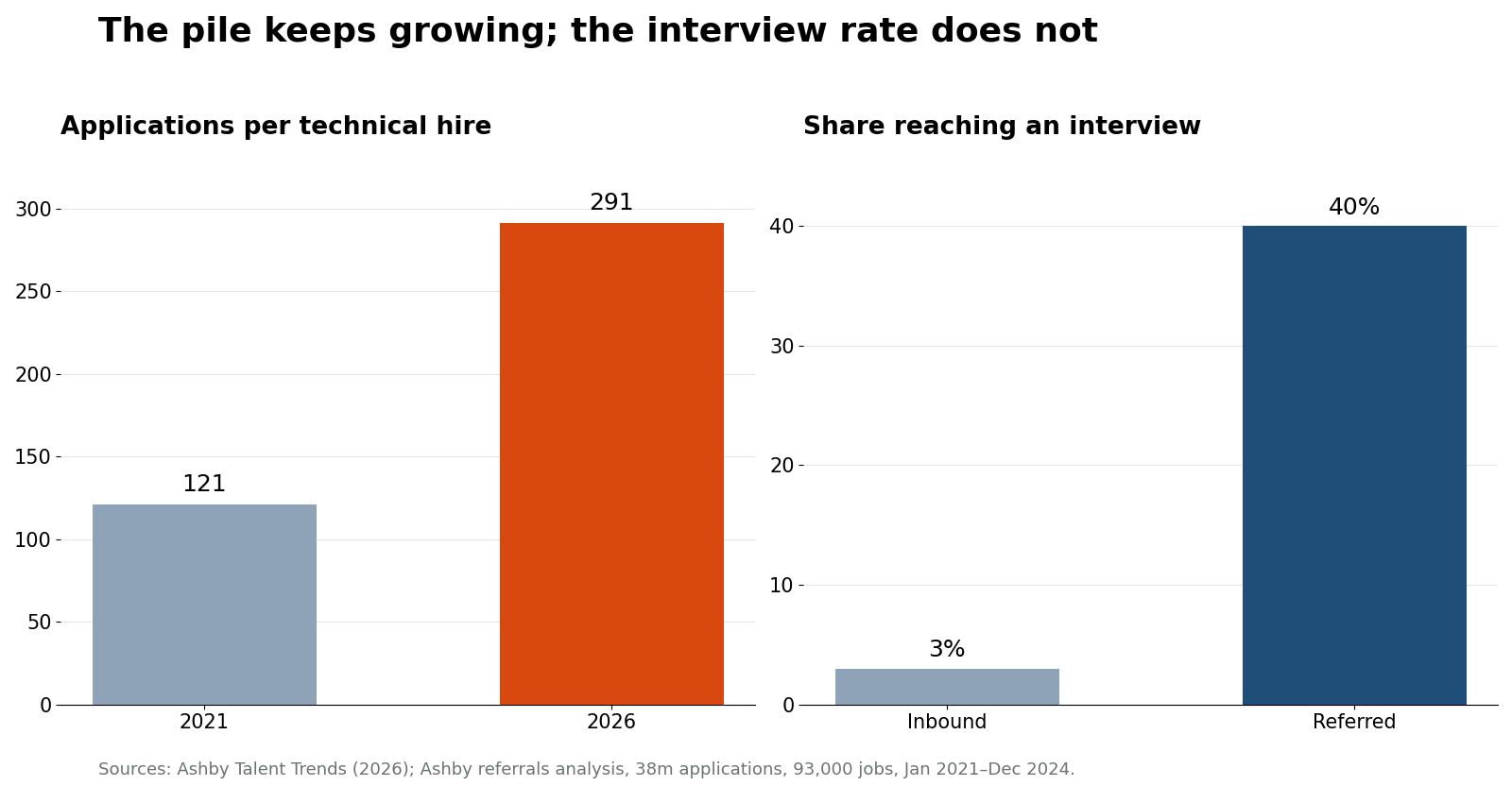
A technical hire now takes 291 applications, on average. That is up from 121 in 2021. The number comes from Ashby's Talent Trends data. It has more than doubled in five years, and the rise tracks the arrival of tools that let anyone apply to everything.
Most of those applications go nowhere. In Ashby's analysis of more than 38 million applications across 93,000 jobs, from January 2021 to December 2024, 3% of inbound applicants reached an interview. Referred candidates reached an interview 40% of the time.
Read those two numbers together. A hiring manager who reads inbound applications is spending nearly all of their time on candidates who will not get an interview. A hiring manager who starts with referrals is spending most of their time on candidates who will.
The gap is not about quality of writing. It is about information. An application tells you what a candidate claims. A referral tells you what someone who has worked with the candidate thinks. AI can generate the first. It cannot generate the second.
Our own data shows the scale of what hiring managers are looking at. We crawled the public job boards of 803 companies and recorded 34,097 open roles. The median company has 15 roles open. The largest have hundreds — OpenAI with 838 roles, Stripe with 707, Databricks with 659, Anthropic with 632.
And the roles themselves are noisy. Speechify, the company with the most postings in our file at 735, is posting the same three roles — "Software Engineer, AI Data", "Tech Lead, Android Core Product", and "Team Lead, Android Core Product" — once per location, in city after city: 490 of the 735 roles labelled Lead. That is one hiring need, expressed as hundreds of postings. A candidate applying to all of them is not applying to hundreds of jobs. They are applying to one job, hundreds of times.
Why the usual fixes do not work
The instinct is to add a filter. A keyword screen. A knock-out question. A take-home test before the first call. An AI tool to read the AI applications.
Each of these makes the problem worse in a different way.
Keyword filters are the easiest to game and the hardest on the best candidates. A senior engineer who has built the exact system you need will not always use your exact words for it. A generated application will use all of them, because the model read your job description and mirrored it back. The filter passes the mirror and fails the person.
Take-home tests before a first conversation punish the people you most want. A senior engineer with a job, a family, and three other companies talking to them will not spend a weekend on an unpaid assignment for a company they have not yet met. A candidate with nothing else going on will. You have filtered for availability, not ability.
What works: a small set, referral first
The practical fix has three parts.
1. Start with a small set, not a pile.
Before the role posts, name five to ten people you would want to hire. Not from applications — from your team's judgment, from people you have worked with, from referrals, from public work you have read. These are the candidates. Everyone else is a backup.
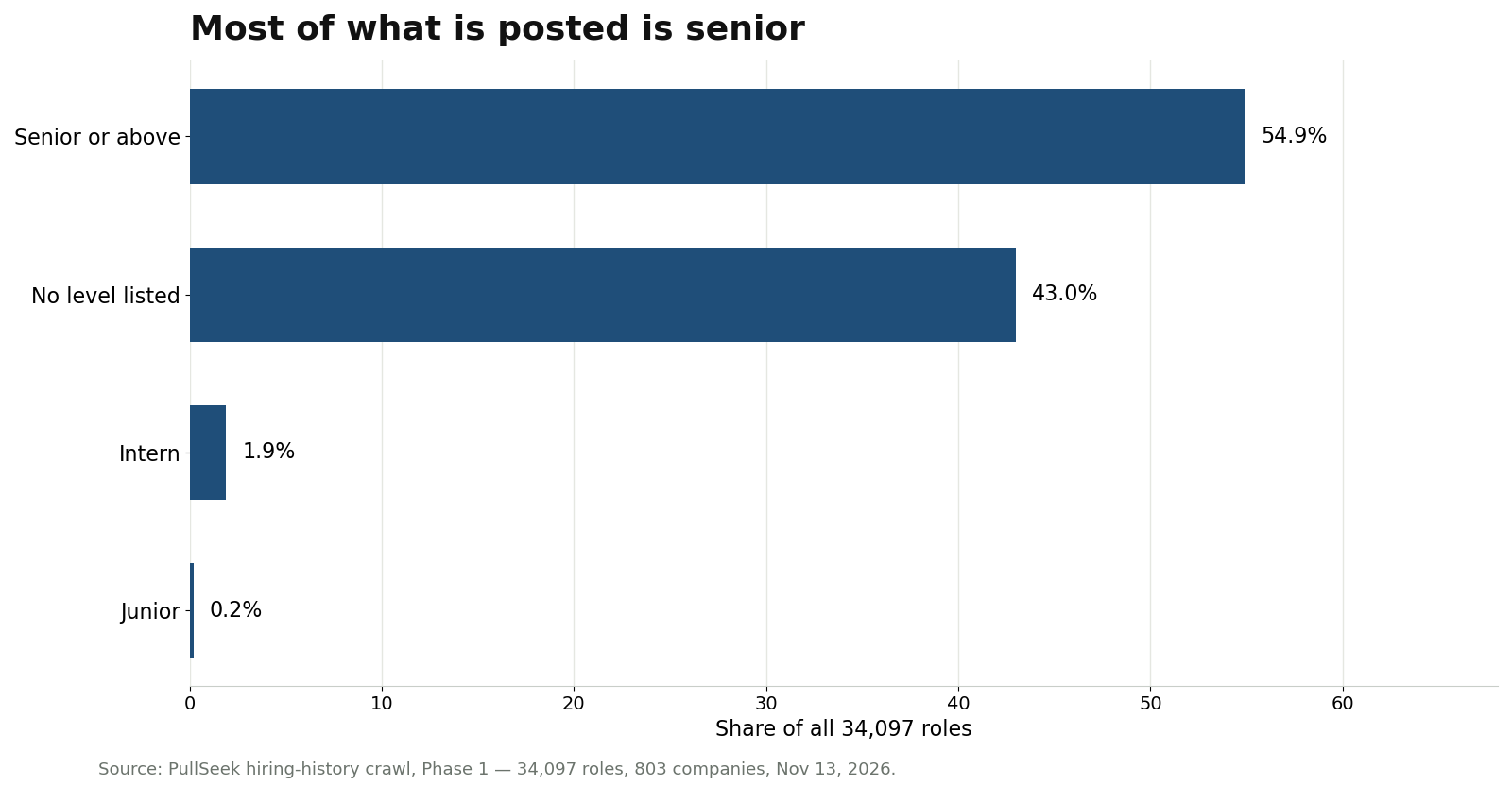
Our data says this is where the hiring actually is. Of the 34,097 roles in our file, 54.9% are labelled Senior or above, and among the roles that state a level, 96.3% are Senior or above. For engineers, 5,980 of 10,133 roles are Senior-level or above, across 561 companies. Senior roles are not filled from a cold pile. They are filled by people the hiring manager already trusts, or by someone a trusted person vouches for. Start there, and the pile matters less.
2. Screen on referral, then on conversation.
The referral is the filter AI cannot fake. Someone who has worked with the candidate is putting their own reputation on the line. That is the signal. Ashby's numbers say it plainly: 40% of referred candidates reach an interview, against 3% of inbound applicants. A referral-first process does not mean ignoring inbound applications. It means reading them after you have talked to the referred candidates, not before.
Then screen on a conversation, not a document. Thirty minutes with the hiring manager, about the actual work. A senior engineer can talk about a system they built in a way a model cannot fake — the trade-offs, the mistakes, the parts that did not work. A generated resume cannot survive a good conversation. A real engineer can.
3. Let the application be the last step.
The application exists for a reason: compliance, records, the hiring system. Let it be paperwork. The decision should be made before the form is filled in, not by the form.
This also fixes the volume problem at its root. If the hire comes from a small set of known people, the pile can be as large as it wants. It does not matter how many generated applications arrive, because you are not reading them first. You are reading them last, if at all.
What to stop doing
Stop posting a role and waiting. The posting is the last step of a hiring process, not the first. If the role posts before you have names in mind, the pile is all you have.
Stop keyword filtering. It passes the mirror and fails the person. If you must use a screen, screen on a short conversation, not a document.
Stop mass outreach. Sending the same message to fifty engineers is how you get ignored by exactly the people you most want to reach. Senior engineers talk to each other. One careful note, sent to the right person, is worth more than a hundred templated ones.
What PullSeek does differently
PullSeek exists because the small-set approach is right and hard to do by hand at scale.
We watch 101,498 fast-growing companies, starting with the US. We predict which roles each one is likely to hire in the next 12 months — the role, the level, and the profile that fits. We map the people behind each predicted role: the likely hiring manager, the team lead, the peers. And we draft the introduction to a specific person, which you approve before anything is sent.
For the hiring manager, that means the small set arrives before the posting does — five to ten people, matched to the predicted role, introduced through a real connection, before the application pile exists.
You do not need PullSeek to do this. Five names, three referrals, one good conversation — that works on its own. PullSeek does it at a scale no person can: every company, every signal, every quarter. The work is the same. The coverage is not.
The bottom line
AI made applications free, and free applications buried the signal. The way out is not a better filter. It is a different order: small set first, referral first, conversation first, application last.
The real candidates were never in the pile. They were in the room next door, doing the work, known to someone you already trust. Start there.
Methodology
Figures in this post were computed from PullSeek's hiring-history crawl, Phase 1 file: 34,097 roles across 803 companies, fetched November 13, 2026, from public Greenhouse, Ashby, and Lever job boards. Role levels are as listed on the boards; 14,668 rows (43%) carry no level label. Senior engineering roles are roles with 'engineer' in the title and a level of Senior, Staff, Principal, Lead, Director, or Manager: 5,980 roles across 561 companies. Roles with 'engineer' in the title total 10,133. Speechify holds 245 roles with 'engineer' in the title, all titled "Software Engineer, AI Data" with a location suffix and none carrying a level label; its 490 Lead-labelled roles are titled "Tech Lead" or "Team Lead, Android Core Product" and do not contain 'engineer', so they are not counted here.
The wider hiring-history corpus holds 51,129 deduped role rows across 1,611 companies crawled. The PullSeek company directory holds 101,498 companies. The Inc 5000 database holds 5,003 US high-growth companies.
External figures: Ashby Talent Trends — 291 applications per technical hire (2026, up from 121 in 2021); Ashby referrals analysis — 40% of referred candidates reached an interview vs 3% of inbound applicants, from 38 million applications across 93,000 jobs, January 2021 to December 2024 (published May 2025).
Related insights
Start with the small set.
PullSeek predicts the roles companies will hire in the next 12 months and puts five to ten matched people in front of you before the posting — before the pile exists. Your first connected role is free.
Get started