Will AI replace software engineers — and which jobs are actually at risk?
The short answer: the hiring data shows AI adding a new kind of engineering job, not removing the old kind. Software engineers still outnumber AI-titled roles about five to one — and the AI roles themselves are mostly senior.
The short answer: the hiring data shows AI adding a new kind of engineering job, not removing the old kind. Software engineers still outnumber AI-titled roles about five to one — and the AI roles themselves are mostly senior.
The question is usually asked as a prediction about the future. It is better answered as a measurement of the present. What are companies actually hiring for, right now, in what numbers, and at what level? That is a question data can answer.
AI roles are real, and small next to software engineering
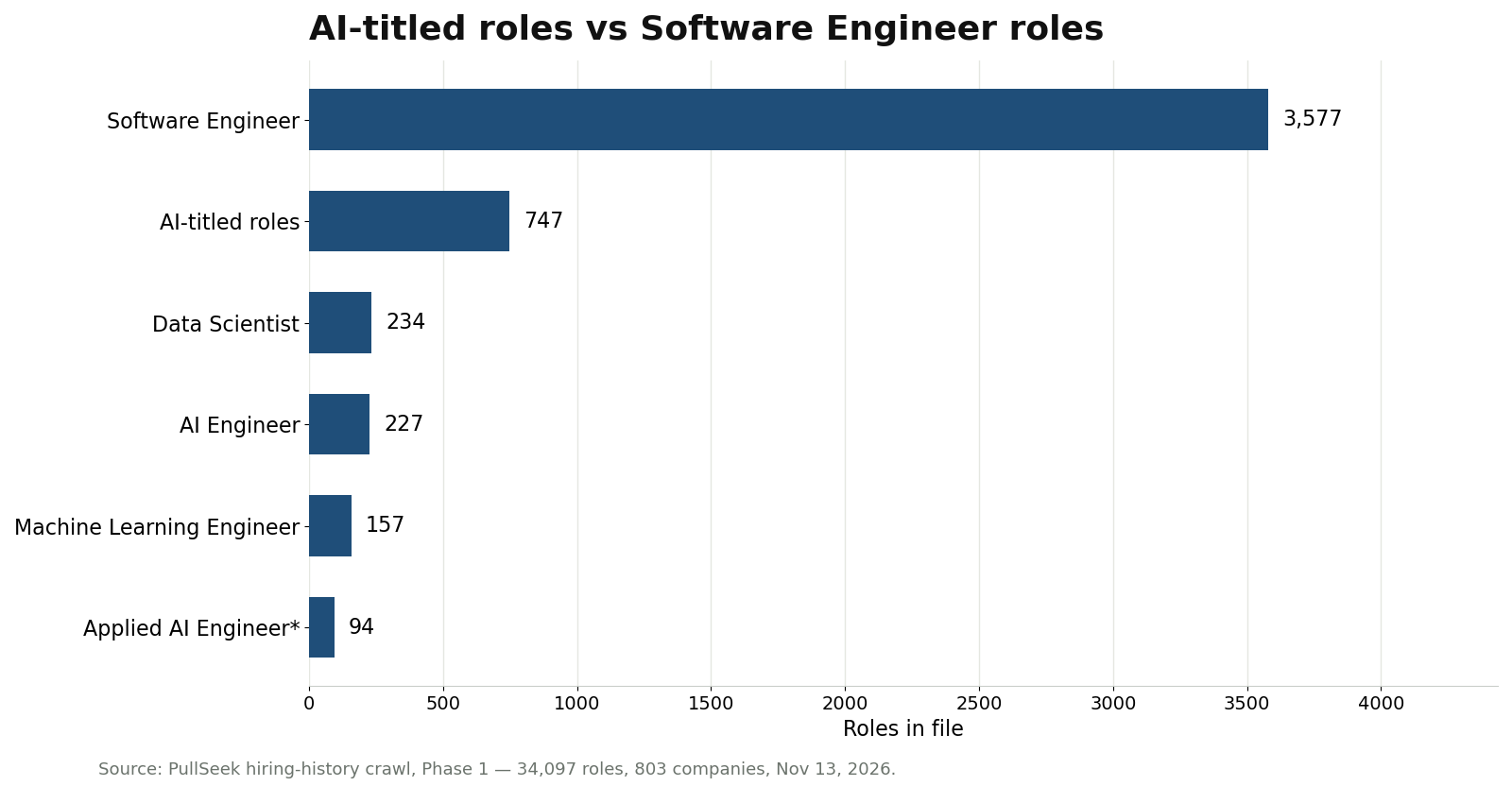
We crawled the public job boards of 803 companies and recorded 34,097 open roles. Of those, 747 carry an AI-specific title: AI Engineer, Machine Learning Engineer, Applied AI Engineer, LLM Engineer, Generative AI Engineer, AI Research Scientist, Deep Learning Engineer, and close variants. That is 2.2% of all roles in the file, and 7.4% of the 10,133 engineer-titled roles.
By comparison, 3,577 roles carry "Software Engineer" in the title. That is roughly five software engineering roles for every one AI-titled role. Software engineering roles appear at 417 companies. AI-titled roles appear at 205 companies — about a quarter of the companies in the file.
The most common AI titles are not exotic. Titles containing "AI Engineer" appear 227 times — that count includes Applied AI Engineer variants, of which there are 94. Titles containing "Machine Learning Engineer" appear 157 times. "Data Scientist" appears 234 times. These are established titles now, not experiments. But they are still a small fraction of engineering hiring.
The wider picture is the same. Non-engineering roles are 70.3% of the file. Engineering as a whole is 30.8%. AI is a slice of a slice.
The AI roles are senior roles
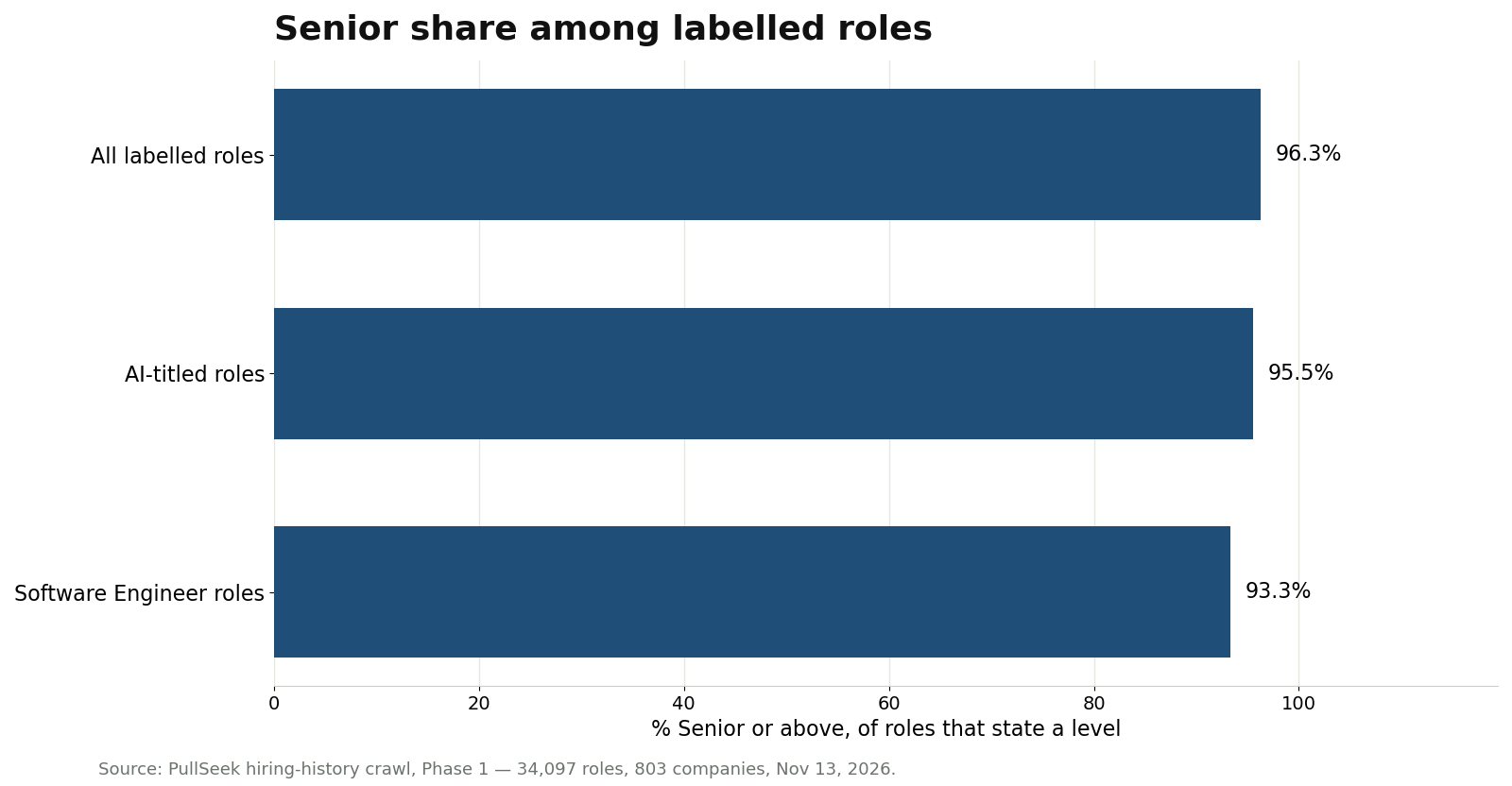
The second thing the data shows is the level. Of the 747 AI-titled roles, 446 carry a level label. Of those, 426 — 95.5% — are Senior or above. For software engineering roles, the equivalent figure is 93.3%.
AI Engineer roles specifically: 227 in the file, 98 with a level label, and the labelled ones run Senior (51), Staff (16), Principal (11), Manager (9), Lead (4), Director (1), Intern (6). There is almost no junior AI hiring in this data. One AI-titled role in the file is labelled Junior.
That matters, because the jobs most often described as "at risk" from AI are junior ones: the routine coding, the boilerplate, the first-draft work. The hiring data does not contradict that fear directly — it shows something adjacent to it. Companies are barely hiring junior engineers at all, in any function. Only 717 roles in the entire file are labelled Intern or Junior, 3.7% of labelled roles. The junior pipeline on public job boards is thin across the board, not just in AI.
That is consistent with what developers themselves report. In Stack Overflow's 2025 Developer Survey, of more than 49,000 respondents from 177 countries, 84% said they use or plan to use AI tools in their development process, up from 76% in 2024. But 46% said they do not trust the accuracy of AI output, up from 31% the year before. And 64% said they do not perceive AI as a threat to their jobs, down only slightly from 68% in 2024.
Read those three numbers together and the picture is clear. Developers use the tools. They do not trust the output. They do not expect to be replaced.
Which jobs are actually at risk
The data cannot tell you which jobs will disappear. It can tell you where the pressure is, by showing which work is already scarce in hiring.
The most exposed roles are the ones defined by volume and repetition. A role whose day is mostly writing boilerplate, translating a spec into straightforward code, or producing first drafts that someone else reviews is a role where an AI tool is already doing part of the work. The Stack Overflow numbers support that reading: 84% adoption, 46% distrust. The tool is used for the draft. A person is still needed for the judgement.
The least exposed roles are the ones defined by judgement under uncertainty. Deciding what to build. Debugging a system nobody fully understands. Owning a production incident. Negotiating a trade-off between two bad options with a customer on the line. None of that appears in a job title, which is why title counts alone cannot settle the question. But the senior skew is a proxy: the market is paying for judgement, and paying more for it than before.
What to do about it
If you are a software engineer, the practical read is straightforward.
First, use the tools. 84% of developers already do. The cost of not using them is now higher than the cost of learning them. The developers who fall behind will not be the ones AI replaces. They will be the ones who refused the tool their peers adopted.
Second, move toward the judgement work. The parts of the job that are hardest to automate are the parts this data shows companies hiring for at senior levels: system design, debugging, owning outcomes, working with customers. A Staff or Principal engineer is not paid to type faster. They are paid to be right about hard calls. Build that record.
Third, do not confuse a new title with a new career. "AI Engineer" is 227 roles in a file of 34,097. It is a real job, but it is a small door. The bigger door is the one already open: a software engineer who can build with AI systems, ship them, and stand behind them. That is what the 205 companies hiring AI roles are actually buying, whether the title says AI or not.
One honest note: this file is a snapshot of open roles, not a time series. We cannot show AI roles growing or shrinking over time from this file, because dated roles skew toward recent months — the crawl captured what was open in November 2026, and older postings have mostly closed. We will publish the trend when we have a second and third crawl to compare. Until then, treat this as a level, not a direction.
What PullSeek does differently
PullSeek watches 101,498 fast-growing companies and predicts which roles each one is likely to hire in the next 12 months — the role, the level, and the profile that fits. For an engineer, that means the prediction runs before the posting: which companies are about to need the skills you have, and who inside those companies you should know first.
A job board tells you what is open now. We tell you what is likely to open next, so the relationship starts before the posting — when it still matters.
Every prediction is graded. When the window closes, we compare the prediction against the job description the company actually published. That score is the product. If the predictions are wrong, nothing else matters.
The bottom line
AI is not replacing software engineers in the hiring data. It is adding 747 specialised roles next to 3,577 software engineering roles, and the new roles are overwhelmingly senior.
The job at risk is not "software engineer." It is the version of the job that is only typing. The version that survives is the one built on judgement — and the data says that is the version companies are hiring for.
Methodology
Figures in this post were computed from PullSeek's hiring-history crawl, Phase 1 file: 34,097 roles across 803 companies (by domain), fetched November 13, 2026, from public Greenhouse, Ashby, and Lever job boards. AI-titled roles were counted by title keywords: "AI Engineer", "Machine Learning", "ML Engineer", "Applied AI", "Artificial Intelligence", "LLM", "GenAI", "Generative AI", "AI Research", "AI Scientist", and "Deep Learning" — 747 roles. The broad count of 974 adds "Data Scientist". "Software Engineer" roles were counted by that exact phrase in the title — 3,577 roles; including "Software Developer" the count is 3,626. Role levels are as listed on the boards; 14,668 rows (43%) carry no level label. "Senior or above" means Senior, Staff, Principal, Lead, Director, Manager, VP, or Executive.
The wider hiring-history corpus holds 51,129 deduped role rows across 1,611 companies crawled. The PullSeek company directory holds 101,498 companies. The Inc 5000 database holds 5,003 US high-growth companies.
External figures: Stack Overflow 2025 Developer Survey (published July 29, 2025; more than 49,000 respondents from 177 countries) — 84% of developers use or plan to use AI tools in development, up from 76% in 2024; 46% do not trust the accuracy of AI output, up from 31% in 2024; 64% do not perceive AI as a threat to their jobs, down from 68% in 2024.
Related insights
Bet on the work, not the title.
PullSeek predicts the roles companies will hire in the next 12 months and introduces you to the people inside before the job exists. Your first connected role is free.
Get started