AI Engineer vs ML Engineer vs Software Engineer — which title should I bet on?
The short answer: bet on Software Engineer for volume, ML Engineer for senior density, and AI Engineer for direction — not for the title itself.
The short answer: bet on Software Engineer for volume, ML Engineer for senior density, and AI Engineer for direction — not for the title itself.
The three titles describe overlapping work. The market does not treat them equally. Software Engineer is where most of the senior jobs are. ML Engineer is the smallest pool and the most senior-heavy. AI Engineer is the fastest-moving label and the least settled — most of the roles carry no level at all, and most companies posting one post exactly one.
If you are a senior engineer choosing where to aim, the title matters less than the team behind it — but the numbers say where each bet pays off.
The three pools, counted
We classified every role in the file into three families by title text: "Machine Learning Engineer" and "ML Engineer" count as ML Engineer; "Applied AI Engineer," "AI Platform Engineer," and "AI/ML Engineer" count as AI Engineer; "Software Engineer" and its variants count as Software Engineer.
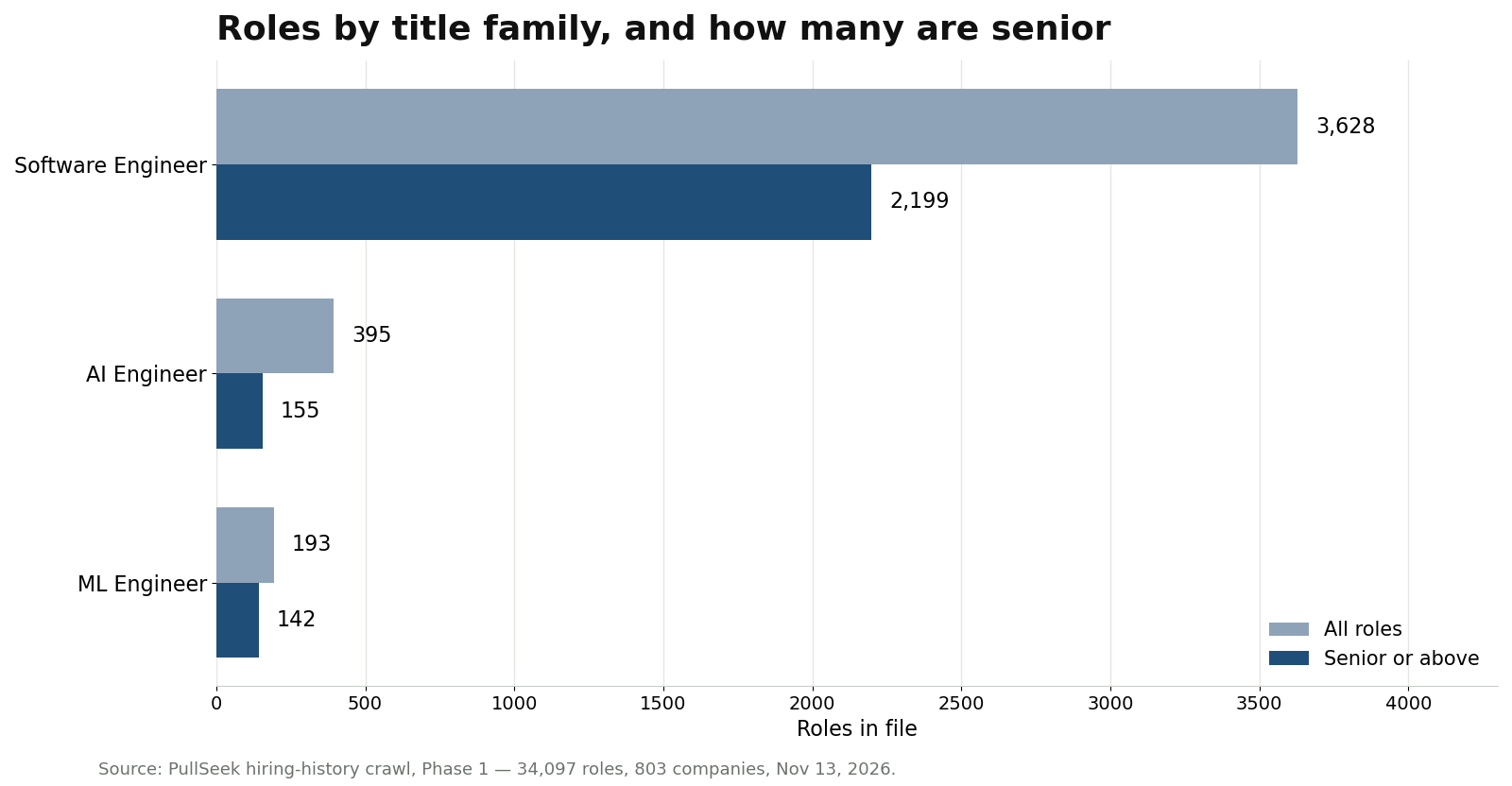
Software Engineer is the big pool: 3,628 roles, posted by 417 companies. Roughly nine times the size of the AI Engineer pool.
AI Engineer is the middle pool: 395 roles, posted by 170 companies. The most common titles are Applied AI Engineer (18), AI Engineer (12), and Senior AI Engineer (11); the rest scatter across dozens of variants.
ML Engineer is the smallest pool: 193 roles, posted by 90 companies. The most common titles are Senior Machine Learning Engineer (15), Staff (7), and Principal (6). The label is older and more settled — the titles read like a career ladder, not a brainstorm.
Together, AI and ML Engineer are 588 roles — 5.8% of the 10,133 engineer-titled roles in the file.
The senior mix is where the titles separate
By the broadest count — Senior, Staff, Principal, Lead, Director, or Manager — they look very different.
ML Engineer is the most senior-heavy: 142 of 193 roles (73.6%) are Senior or above, and 53 (27.5%) are Staff or Principal. It is a senior discipline with a junior door that barely exists.
Software Engineer sits in the middle: 2,199 of 3,628 roles (60.6%) are Senior or above, and 769 (21.2%) are Staff or Principal. But the absolute numbers matter most — 2,199 senior roles, against 297 for AI and ML Engineer combined.
AI Engineer looks weakest on this measure, but the reason matters: only 155 of 395 roles (39.2%) carry a Senior-or-above label — because 236 (59.7%) carry no level label at all. Among the roles that do state a level, 97.5% are Senior or above, the highest of the three families. The title is so new that companies often do not label the level. The work is senior. The paperwork has not caught up.
That cuts both ways. An unlabeled AI Engineer role might be a senior job with a vague posting, or a role the company has not thought through yet. You cannot tell from the title. You have to talk to the team.
The honest summary: ML Engineer for senior density, Software Engineer for the most senior roles, AI Engineer for the newest label — with the thinnest postings.
Most companies post one AI Engineer, not a team
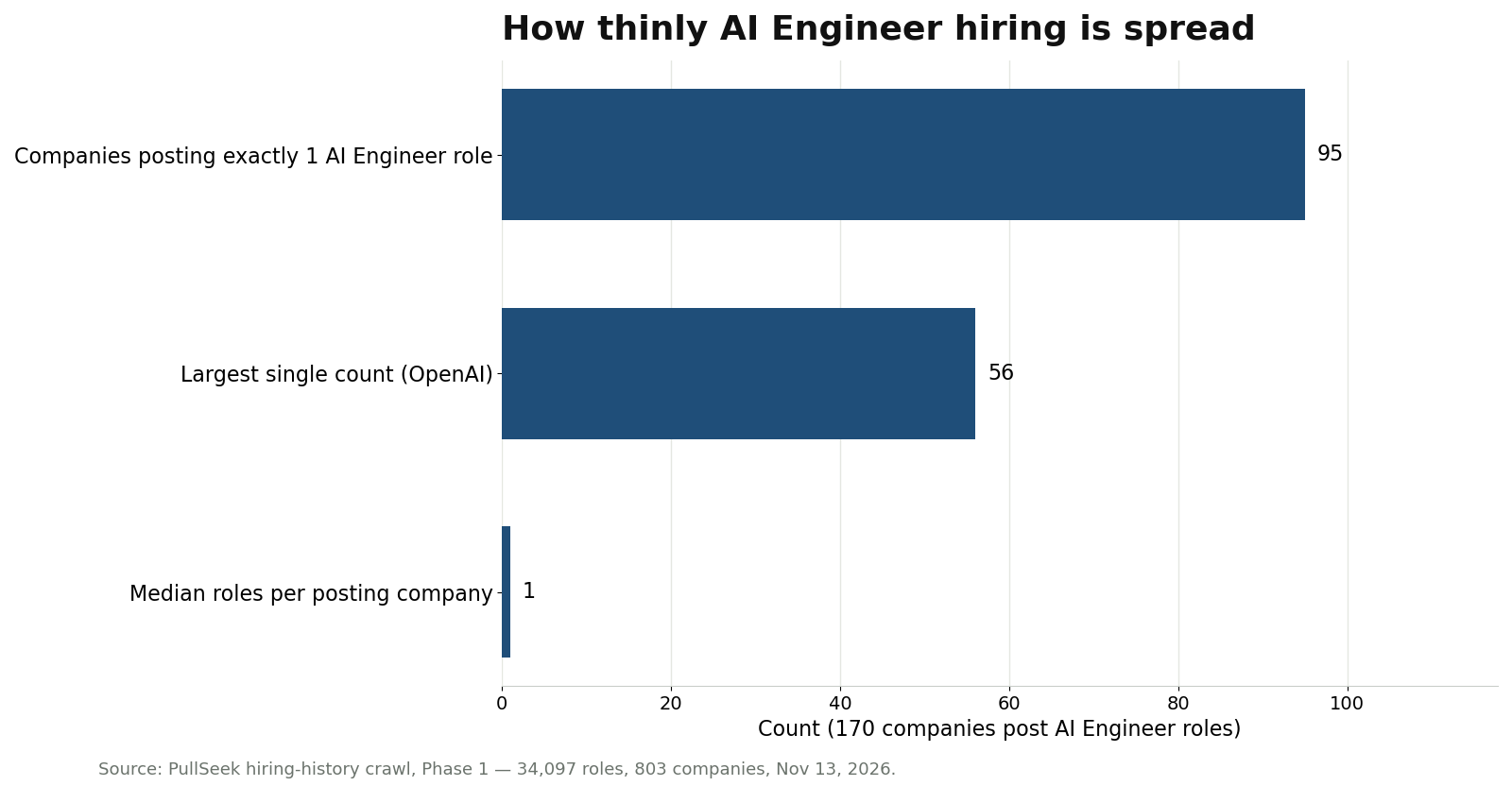
AI Engineer hiring is thinly spread.
The median company posting AI Engineer roles posts exactly one; 95 of 170 post a single role. The mean is 2.3, pulled up by one outlier: OpenAI, with 56. The next three — Anthropic, Celonis, Databricks — post 11 each.
ML Engineer is the same shape, smaller. The median company posts one ML Engineer role. The largest counts are Airbnb with 12, Stripe with 9, and Roblox with 8.
What this means in practice: an AI Engineer opening is usually a single seat on a team that is trying something, not a hiring program. There is one role, one hiring manager, and a short window — exactly the kind of role that gets filled by someone the team already knows.
The AI title is usually an addition to a team that already hires Software Engineers, not a replacement: 136 of the 170 AI-posting companies also post Software Engineer roles, and 78 of the 90 ML-posting companies do too. The title is new. The org is not.
So the bet is not "AI Engineer instead of Software Engineer." It is "Software Engineer who can do the AI work" versus "AI Engineer only" — 3,628 roles against 395, most of them single seats.
What to do with this
If you are a senior engineer deciding where to aim over the next year, here is the plain version.
Keep Software Engineer as your base. It is the title with the most senior roles, the most companies, and the most Staff and Principal seats in absolute terms. A senior Software Engineer who has shipped AI features is employable at 417 companies in our file. A pure AI Engineer title is employable at 170, mostly one seat at a time.
Treat ML Engineer as the specialist bet. It is the smallest pool, but the most senior-dense: nearly three in four roles are Senior or above, and more than one in four is Staff or Principal. If you have real ML depth — models in production, not tutorials — this is the title where the level matches the work. But there are 193 roles. You need to know the specific teams.
Treat AI Engineer as a direction, not a destination. The label moves fast and means different things at different companies: an Applied AI Engineer at one builds evals; at another, it wraps an API. Before you chase the title, read the actual role — what the team ships, who the manager is, whether the seat is senior in practice. With 59.7% of AI Engineer roles carrying no level label, the title alone tells you less than the other two.
Do not rebrand yourself out of your strongest evidence. If your best work is building and shipping software, a resume that says "AI Engineer" does not help you. The hiring manager is buying the last thing you shipped and whether it resembles their hardest problem — not the title.
Aim at the team, not the title family. OpenAI has 56 AI Engineer roles. Most companies have one. A single AI Engineer seat at a company whose product you understand is a better bet than ten postings at companies you cannot name a problem for.
What PullSeek does differently
PullSeek predicts the roles companies will hire in the next 12 months — the role, the level, and the profile that fits — and connects you with the people inside before the job posts.
For title bets, that matters because the title is the least stable part of the prediction. A company that will hire one AI Engineer in six months does not look like a hiring program from the outside. It looks like nothing, until the posting appears. We watch for the signals that precede it — a team forming, a leader hired, a product direction that needs the seat — and we map the people behind the predicted role so the introduction happens before the posting, when a single seat is still winnable.
You do not need PullSeek to make this bet. The numbers above are enough to aim well. PullSeek does it at a scale no person can — every company, every signal, every quarter — and it starts the relationship before the single seat is posted.
The bottom line
Software Engineer is the bet with the most senior roles behind it. ML Engineer is the bet with the highest senior density. AI Engineer is the bet on where the work is going — real, growing, and still too unsettled to carry your whole search on its own.
Bet on the work you can show, under the title with the most doors behind it. Let the AI label describe what you do, not define what you are.
Methodology
Figures in this post were computed from PullSeek's hiring-history crawl, Phase 1 file: 34,097 roles across 803 companies (by domain), fetched November 13, 2026, from public Greenhouse, Ashby, and Lever job boards. Title families were classified from role-title text: Software Engineer (3,628 roles, 417 companies), AI Engineer (395 roles, 170 companies — including Applied AI Engineer, AI Platform Engineer, AI Systems Engineer, and AI/ML Engineer), and ML Engineer (193 roles, 90 companies — including Machine Learning Engineer and ML Engineer). "Senior or above" means Senior, Staff, Principal, Lead, Director, or Manager, the same definition as post #1. Role levels are as listed on the boards; 14,668 rows (43%) carry no level label. Engineer-titled roles total 10,133 across 644 companies.
The wider hiring-history corpus holds 51,129 deduped role rows across 1,611 companies crawled. The PullSeek company directory holds 101,498 companies. The Inc 5000 database holds 5,003 US high-growth companies.
No external salary or title-trend data was used in this post. The comparison rests entirely on the counts above.
Related insights
Aim at the team, not the title.
PullSeek predicts the roles companies will hire in the next 12 months and introduces you to the people inside before the job exists. Your first connected role is free.
Get started