What is a Forward Deployed Engineer — and is it the best move for a senior in 2027?
The short answer: a Forward Deployed Engineer is a senior engineer who works at the customer's site, not the company's. It is real, it is no longer rare, and it is the best move for a senior who wants customer proximity and ownership — and the wrong move for a senior who wants to build product in peace.
The short answer: a Forward Deployed Engineer is a senior engineer who works at the customer's site, not the company's. It is real, it is no longer rare, and it is the best move for a senior who wants customer proximity and ownership — and the wrong move for a senior who wants to build product in peace.
The title barely existed three years ago. Now it is one of the most talked-about roles in engineering. The talk has outrun the data. So here is the data.
The title, counted two ways
The exact title "Forward Deployed Engineer" appears 23 times in our file of 34,097 roles, at 21 companies. That is the number we reported in our first post, and it is verified.
But the exact title understates the role. Companies post the same job under many names: Senior Forward Deployed Engineer (14), Forward Deployed Architect (11), Forward Deployed Software Engineer (7, plus 8 more for US Government work), Staff Forward Deployed Engineer (5). Counting every title that contains "forward deployed", the total is 366 roles across 86 companies — 3.6% of the 10,133 engineer-titled roles in the file.
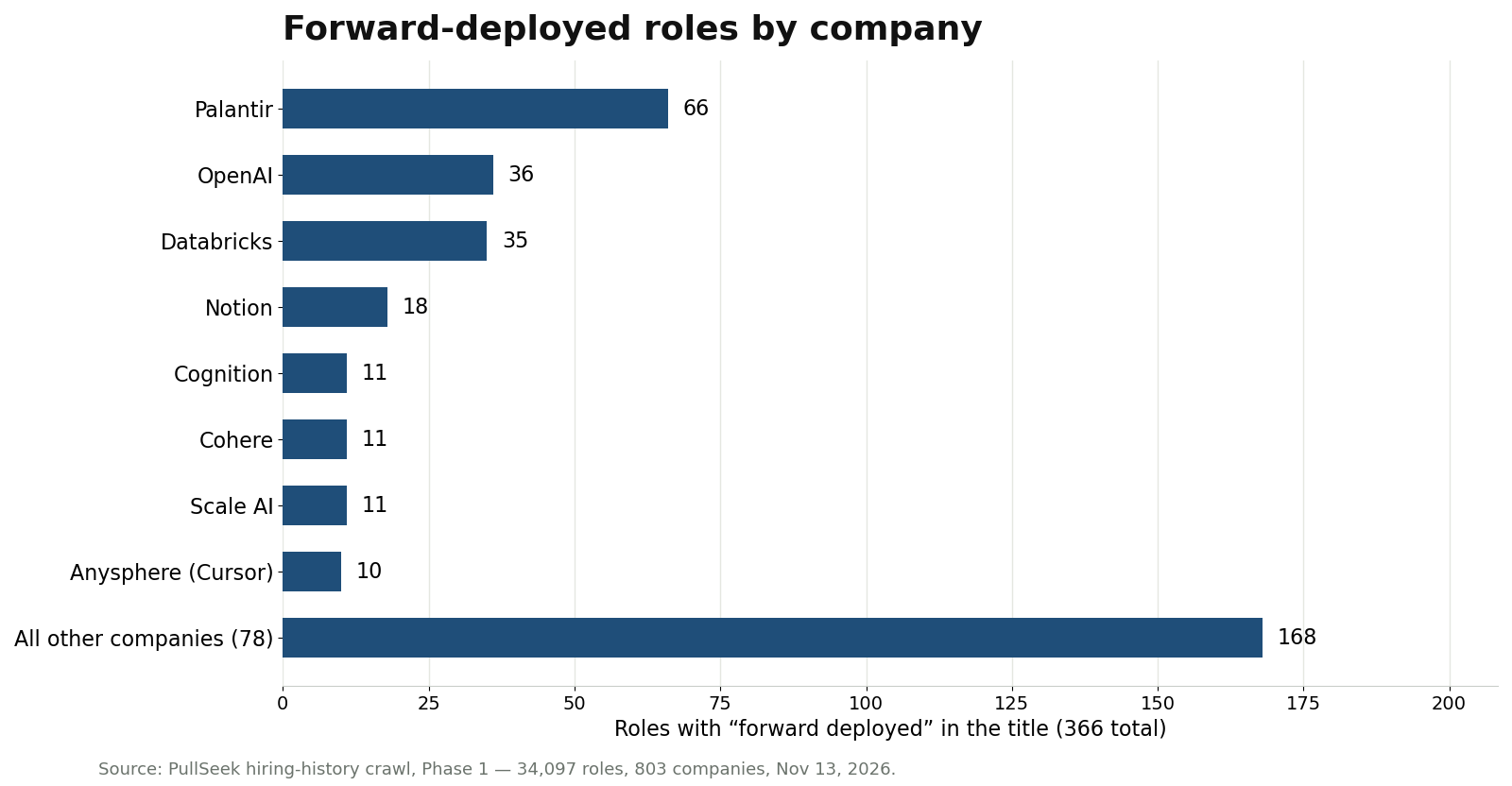
The concentration is the story. Palantir posts 66 forward-deployed roles — the most in the file by a wide margin. OpenAI posts 36. Databricks posts 35. Notion posts 18. Cognition, Cohere, and Scale AI post 11 each. Anysphere, the company behind Cursor, posts 10.
Palantir is where the role comes from. It invented the title: engineers deployed forward, into the customer's organisation, to make the product work on the customer's data, inside the customer's constraints. The role has since spread to the companies building AI products that need the same thing — a person who can take a powerful general system and make it work for one specific customer. 86 companies post the role, from Anthropic and Snowflake to Stripe, Cloudflare, MongoDB, Figma, and Replit. It is a recognised way to sell and deliver complex software, and the companies doing it are the ones whose products are hardest to install: AI platforms, data infrastructure, developer tools, government and regulated-industry software.
It is a senior role
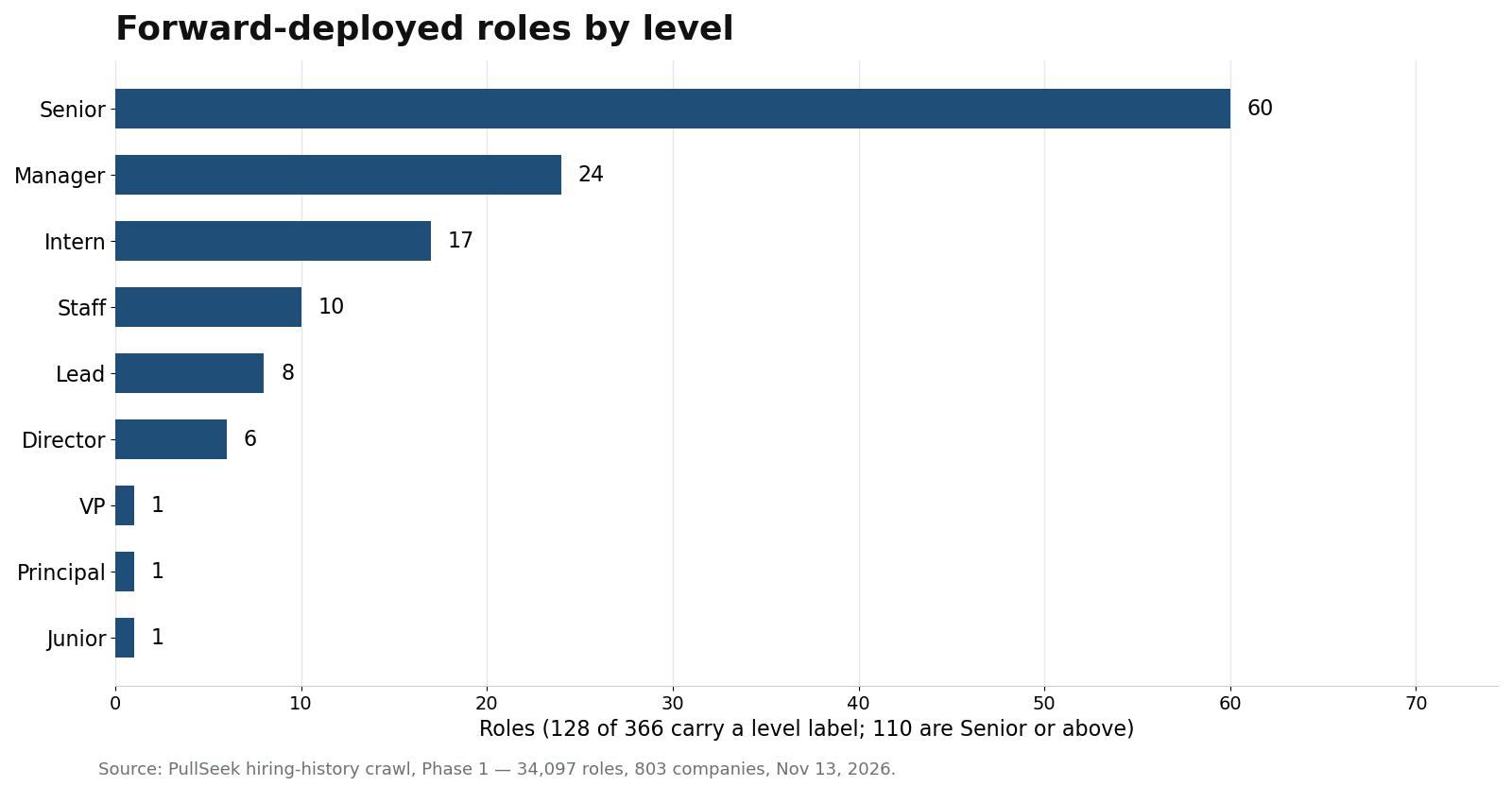
Of the 366 forward-deployed roles, 128 carry a level label. Of those, 110 — 85.9% — are Senior or above. Senior alone accounts for 60. Manager accounts for 24. Staff 10. Lead 8. Director 6. The rest are one VP, one Principal, 17 Intern roles — mostly Palantir's internship pipeline — and one Junior role.
In other words, the role is not an entry point. Companies do not send a junior engineer to a customer's office to make a product work. They send someone who has already shipped, already debugged, already owned an outcome.
What the job actually is
A forward-deployed engineer does three things that a product engineer usually does not.
First, they work on the customer's problem, not the company's roadmap. The product is general. The customer's data, systems, security rules, and workflows are specific. The FDE closes that gap, often by writing code that will never ship to anyone else: integrations, data pipelines, custom workflows, workarounds for the customer's legacy systems.
Second, they own the outcome, not the ticket. The measure of success is a customer using the product in production, getting value from it, and renewing. If the deployment stalls, the FDE is the person in the room.
Third, they carry the customer's voice back to the product team. The FDE sees what breaks, what confuses, what the customer actually asked for versus what the roadmap assumed. The best FDEs are the product team's most honest source of information — and the most ignored, because what they report is usually inconvenient.
Is it the best move for a senior in 2027?
It depends on what you want the next three years to buy you.
Take the role if you want customer proximity and commercial judgement. A senior who has spent five years building product in a back room, and wants to learn how customers actually buy, deploy, and value software, will learn more in a year as an FDE than in three years on a product team. That knowledge compounds. It is the difference between an engineer who can build and an engineer who can decide what is worth building.
Take the role if you want ownership without waiting for a promotion. FDEs own outcomes from the start, because there is no one else in the room. For a senior blocked behind a Staff or Principal promotion queue, the FDE path is a faster way to demonstrate scope: a whole customer, a whole deployment, a renewal number with your name on it.
Take the role if you want to be close to AI deployment rather than AI research. The 317 AI-titled roles at FDE-posting companies are the hiring signal: the industry's AI work is increasingly deployment work. The models exist. The hard problem is making them work for a specific customer, safely, inside their constraints. That is the FDE's job.
Do not take the role if you want deep product work. The code is often integration code, written fast, for one customer, and discarded. If your satisfaction comes from building systems that last, from architecture and craft, the FDE role will frustrate you. The travel, the context-switching, and the customer schedule will eat the deep-work time that a product role protects.
How to judge a specific FDE offer
If you are considering an offer, ask four questions.
First, who owns the outcome? If the answer is "you, end to end, including the renewal" — that is a real FDE role. If the answer is "you write the integration and the account team owns the relationship" — that is a solutions engineering role with a fancier title. Both are fine jobs. They are not the same job.
Second, what happens to what you learn? The best FDE teams have a formal path back into product: the FDE's field notes change the roadmap. The worst treat the FDE as a buffer between the product team and the customer. Ask for an example of something an FDE reported that changed the product.
Third, how is success measured? A renewal, an expansion, a deployment live in production — those are honest measures. Tickets closed or hours on site are not. The measure tells you what the company actually values.
Fourth, what is the exit? Ask where the last three people in the role went. If they went to product or to founding, the role compounds. If they are still FDEs five years later, ask why.
One honest note: we cannot tell from this file whether FDE roles are growing over time, because the file is a single snapshot from November 2026 and dated roles skew recent. What we can say is the level, not the direction: 366 roles, 86 companies, concentrated in AI and infrastructure, and overwhelmingly senior.
What PullSeek does differently
PullSeek watches 101,498 fast-growing companies and predicts which roles each one is likely to hire in the next 12 months — the role, the level, and the profile that fits. For a senior considering a move like this, that means knowing which companies are about to open forward-deployed roles before they post them, and who inside those companies decides.
Every prediction is graded. When the window closes, we compare the prediction against the job description the company actually published. That score is the product. If the predictions are wrong, nothing else matters.
The bottom line
Forward Deployed Engineer is a real role, not a fad: 366 postings across 86 companies, led by Palantir, OpenAI, and Databricks, and overwhelmingly senior.
It is the best move for a senior who wants customer proximity, ownership, and commercial judgement. It is the wrong move for a senior who wants deep product work and a predictable week.
Methodology
Figures in this post were computed from PullSeek's hiring-history crawl, Phase 1 file: 34,097 roles across 803 companies (by domain), fetched November 13, 2026, from public Greenhouse, Ashby, and Lever job boards. Forward-deployed roles were counted two ways: the exact title "Forward Deployed Engineer" (23 roles at 21 companies) and any title containing "forward deployed" (366 roles at 86 companies). AI-titled roles were counted by title keywords: "AI Engineer", "Machine Learning", "ML Engineer", "Applied AI", "Artificial Intelligence", "LLM", "GenAI", "Generative AI", "AI Research", "AI Scientist", and "Deep Learning" — 747 roles. Role levels are as listed on the boards; 14,668 rows (43%) carry no level label.
The wider hiring-history corpus holds 51,129 deduped role rows across 1,611 companies crawled. The PullSeek company directory holds 101,498 companies. The Inc 5000 database holds 5,003 US high-growth companies.
Related insights
See the FDE roles before they post.
PullSeek predicts the roles companies will hire in the next 12 months and introduces you to the people inside before the job exists. Your first connected role is free.
Get started