How do I find out about a job before it's posted on LinkedIn?
The short answer: you don’t find the job. You find the team, months before the job exists.
The short answer: you don't find the job. You find the team, months before the job exists.
By the time a senior role reaches LinkedIn, the search is mostly over. Someone inside already has a name in mind. The posting is the last step, not the first. If you wait for it, you are competing on speed and paperwork. If you get there before it, you are competing on a relationship.
This is not a trick. It is timing.
The posting date is not the start date
A job posting looks like the start of a hiring process. It is the end of one.
The decision to hire is made weeks or months earlier. A budget is approved. A leader is hired. A team plan is written. Then, eventually, someone writes the description and posts it.
We can see this in our own data. We crawled the public job boards of 803 companies and recorded 34,097 open roles. Two things stand out.
First, the posting date tells you almost nothing. Only 40.8% of the roles in our file carry a true posting date at all. Greenhouse, the largest board in the file with 20,170 roles, hides posting dates entirely. The date a role appears on a board is not the date the company decided to hire. In most cases, you cannot even see it.
Second, hiring arrives in bursts, not a steady drip. The median company in our file has 15 roles open. One company, Cursor, posted 69 roles on a single day — November 9, 2026. That is 60% of all its roles in our file, posted at once.
A 69-role day is not 69 separate decisions. It is one decision, made weeks earlier, executed in an afternoon. The people who knew about it before that afternoon were not watching a job board. They were watching the company.
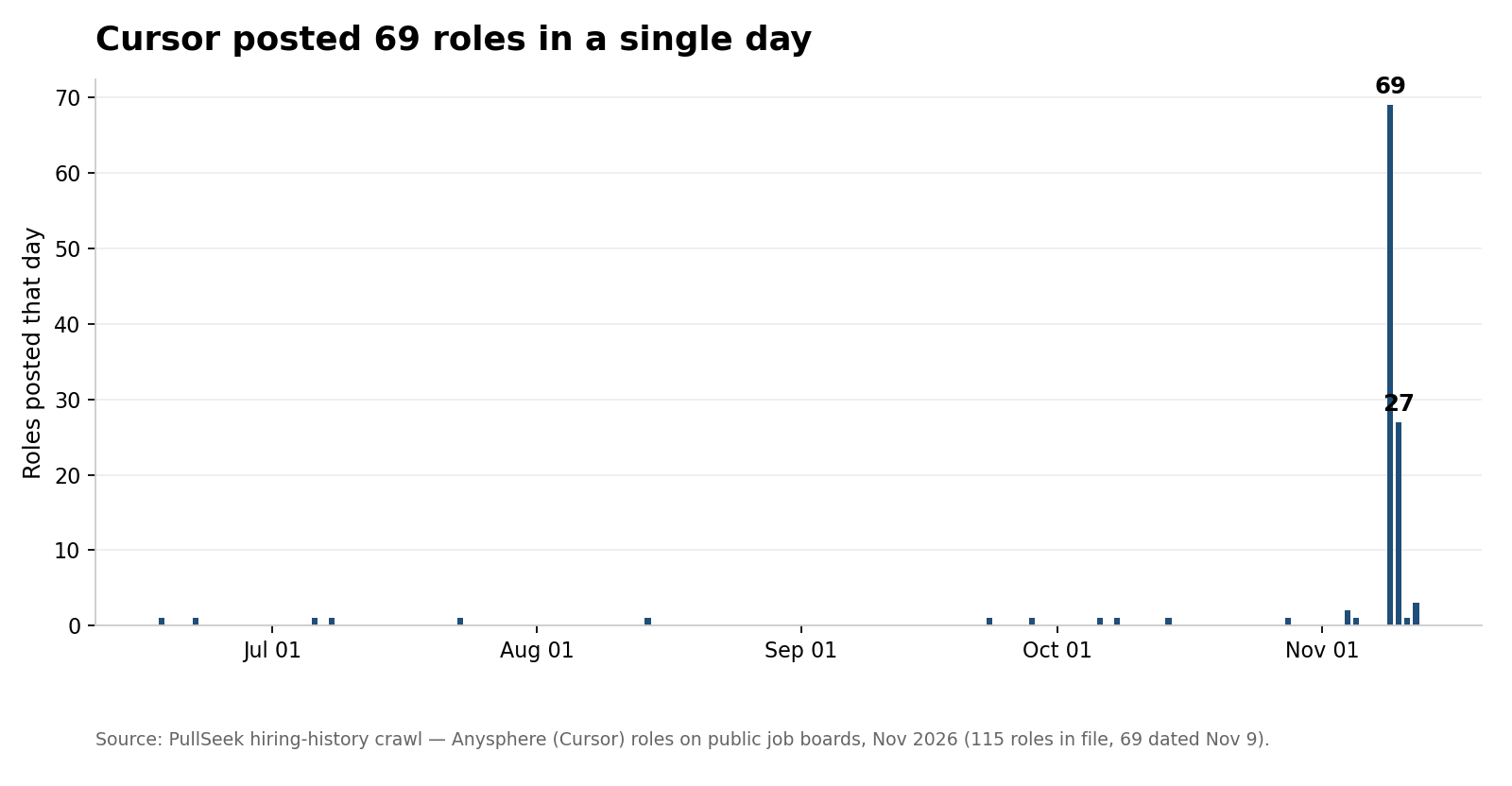
That is the pattern to look for. A team does not hire one person at a time, evenly spaced. It decides, then it posts in a batch. The batch is visible. The decision is not — unless you were paying attention before it.
The math of posting day
The same pattern shows up in other people's data.
A technical hire now takes 291 applications, on average. That is up from 121 in 2021. The number comes from Ashby's Talent Trends data.
Most of those applications go nowhere. In Ashby's analysis of more than 38 million applications across 93,000 jobs, from January 2021 to December 2024, 3% of inbound applicants reached an interview. Referred candidates reached an interview 40% of the time.
That gap is the whole story. The application is not the bottleneck. Being known before the application is.
A referred candidate is not smarter. They are earlier. Someone at the company already knows their name when the req opens. The interview is not a reward for a good resume. It is a conversation with a person the team has already met.
So the question is not how to apply faster. It is how to be known before there is anything to apply to.
Senior hiring is most of the hiring
There is another reason the posting is a bad place to start. Most of what gets posted at the companies we track is senior work.
Of the 34,097 roles in our file, 54% are labelled Senior or above — Senior, Staff, Principal, Lead, Director, or Manager. And 43% of roles carry no level label at all. Among the roles that do state a level, more than 9 in 10 are Senior or above.
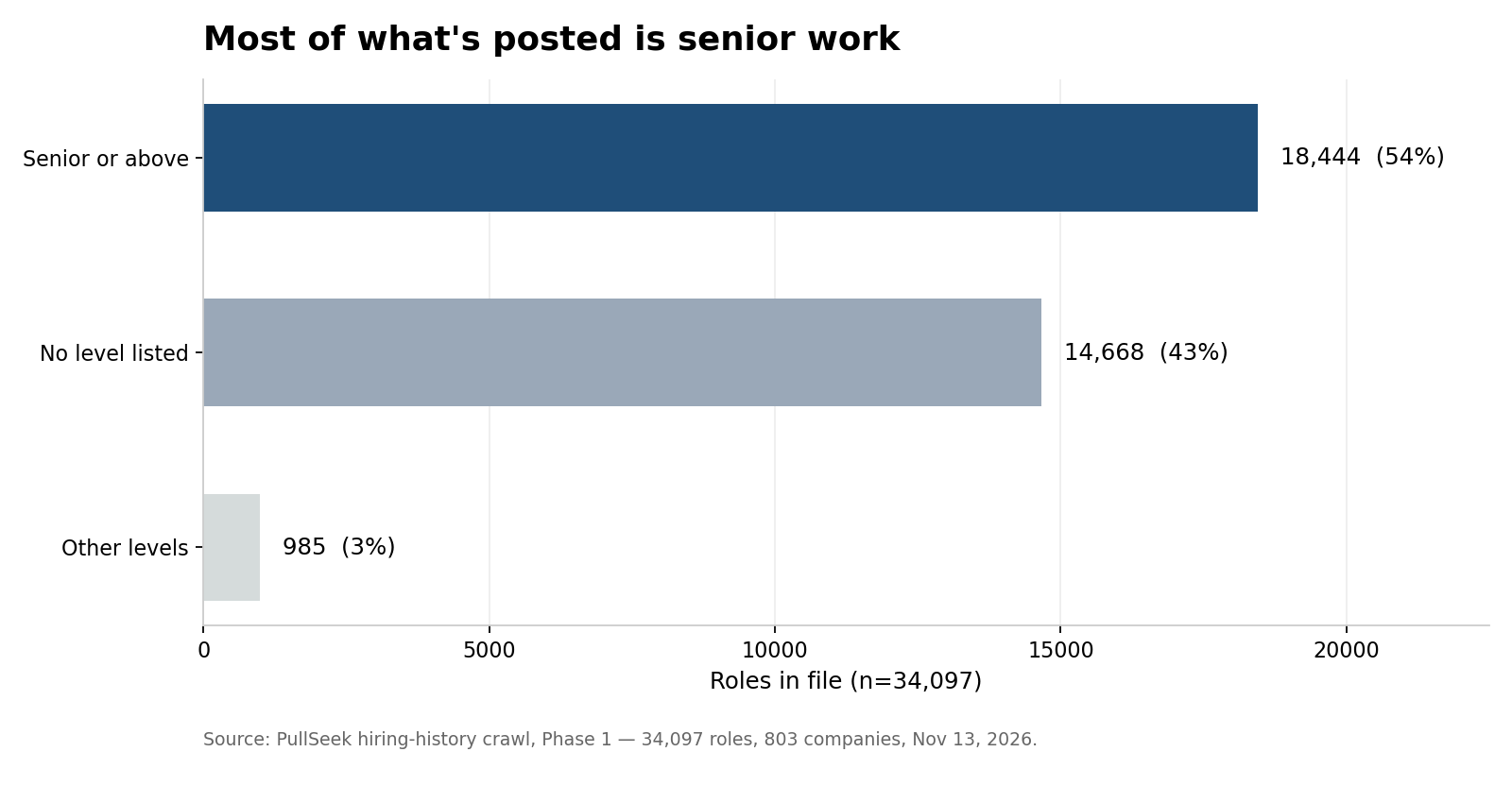
For engineers specifically: 5,980 roles in the file are Senior-level engineering roles or higher, spread across 561 companies. These are not backfills for junior seats. They are the roles that shape a team.
Senior roles are also the ones least likely to be filled from a cold application. They are filled by people the hiring manager already trusts, or by someone a trusted person vouches for. The posting exists because the company has to post it. The hire often comes from somewhere else.
New titles show the same pattern. "Forward Deployed Engineer" appears 23 times in our file — a title that barely existed three years ago. The people who move into new roles early are the ones who saw the role forming, not the ones who searched for the title after it was named.
The three signals that come before the posting
You cannot watch every company. You can watch for three things.
1. Money. A funding round is the most public signal there is. A company that raises money hires. The first wave after a raise is often senior, because the company is buying the people who will build the next version of the product. Watch funding announcements, then watch the company's career page over the following months — not the day of the announcement, but the quarter after it.
2. A new leader. A new VP of Engineering or Head of AI is a hiring plan with a name on it. Leaders build teams. When a senior leader joins, the roles under them follow within a few months. The leader's first hires are usually people they already know — which is why meeting the leader early matters more than meeting the recruiter later.
3. A team growing in public. Headcount climbing on LinkedIn. A new office. A product launch that needs an on-call rotation. A role that stays open for months and gets reposted — a team that cannot fill a seat will often open two more around it. Growth is visible before the req is.
None of this is secret. It is all public. The advantage is not access to hidden information. It is paying attention a few months earlier than everyone else, and doing something with what you see.
One honest note: we have not yet measured the exact lag between a funding round and the first senior hire. Our hiring-history file records roles and posting dates, not funding dates. We are joining the two datasets now, and we will publish the number when we can defend it. Until then, treat the funding signal as direction, not a timetable.
What to do 3 to 6 months before
Knowing a company will hire is not enough. You have to be known by the people who will decide.
Start with a short list. Ten companies, not a hundred. Companies whose product you understand and whose engineering problems you can talk about without a script. If you cannot name the team's hardest problem, you are too early to reach out — read more first.
Find the people, not the req. For each company, that is usually three people: the likely hiring manager, the team lead, and one peer on the team you would join. Their public work — talks, blog posts, open source, papers — tells you what they care about. Read it before you write to them.
Then write one short, specific note. Not a resume. Not "I'd love to connect." One paragraph: what you noticed about their team's work, what you have built that is relevant, and a question worth answering. If the note could be sent to any company, delete it and start over.
Then stay in touch without being a nuisance. A useful update every three to four weeks is enough. Something you shipped. A problem you solved that rhymes with theirs. A short comment on their work that shows you read it. The goal is not to be remembered as persistent. It is to be remembered as competent, when the role appears.
Do not ask for a job that does not exist. Ask for a conversation about the work. The job is the outcome of the conversation, months later — not the subject of the first message.
And keep it quiet. You are employed. You do not need a public "open to work" badge. A direct note to one person is invisible to your employer and far more effective than a signal to everyone.
What PullSeek does differently
PullSeek exists because this process is hard to do by hand for more than a few companies.
We watch 101,498 fast-growing companies, starting with the US. We predict which roles each one is likely to hire in the next 12 months — the role, the level, and the profile that fits. We map the people behind each predicted role: the likely hiring manager, the team lead, the peers. And we draft the introduction to a specific person, which you approve before anything is sent.
The prediction is the point. A job board tells you what is open now. We tell you what is likely to open next, so the relationship starts before the posting — when it still matters.
Every prediction is graded. When the window closes, we compare the prediction against the job description the company actually published. That score is the product. If the predictions are wrong, nothing else matters.
You do not need PullSeek to do this. Ten companies, three people each, one good note — that works on its own. PullSeek does it at a scale no person can: every company, every signal, every quarter. The work is the same. The coverage is not.
The bottom line
The job you want next probably does not exist yet. It will be decided in a meeting you are not in, posted on a Tuesday, and filled by someone the team already knows.
You cannot control the meeting. You can control whether your name is in it.
Start before the posting. That is the whole method.
Methodology
Figures in this post were computed from PullSeek’s hiring-history crawl, Phase 1 file: 34,097 roles across 803 companies, fetched November 13, 2026, from public Greenhouse, Ashby, and Lever job boards. Role levels are as listed on the boards; 14,668 rows (43%) carry no level label. Senior engineering roles are roles with 'engineer' in the title and a level of Senior, Staff, Principal, Lead, Director, or Manager: 5,980 roles across 561 companies. Posting dates are true dates only where the board publishes them (Ashby and Lever); Greenhouse publishes no posting dates, which is why 59.2% of roles in the file have none. The wider hiring-history corpus holds 51,129 deduped role rows across 1,611 companies. The PullSeek company directory holds 101,498 companies. The Inc 5000 database holds 5,003 US high-growth companies. External figures: Ashby Talent Trends — 291 applications per technical hire (2026, up from 121 in 2021); Ashby referrals analysis — 40% of referred candidates reached an interview vs 3% of inbound applicants, from 38 million applications across 93,000 jobs, January 2021 to December 2024 (published May 2025).
Related insights
Start before the posting.
PullSeek predicts the roles companies will hire in the next 12 months and introduces you to the people inside before the job exists. Your first connected role is free.
Get started