How do senior engineers actually get hired without applying anywhere?
The short answer: they get hired before the role exists, by someone who already knows their name.
The short answer: they get hired before the role exists, by someone who already knows their name.
A senior engineer who has never applied for a job is not a mystery. They are the normal case at the top of the market. The posting is the last step of a hiring process, not the first. By the time a senior role reaches a job board, the team usually has a name in mind. The people who get hired without applying are the people whose names were already in the room.
This is not luck. It is a different process, with different rules, and it is visible in the data.
The posting is the last step
We can see this in our own data. We crawled the public job boards of 803 companies and recorded 34,097 open roles. Only 40.8% of those roles carry a true posting date at all. Greenhouse, the largest board in the file with 20,170 roles, hides posting dates entirely. The date a role appears on a board is not the date the company decided to hire. In most cases, you cannot even see it.
Hiring also arrives in bursts, not a steady drip. In our file there are 110 company-days where a single company posted 10 or more roles in one day, and 22 where it posted 20 or more. One company, Cursor, posted 69 roles on November 9, 2026 — 60% of all its roles in our file, posted at once.
A 69-role day is not 69 separate decisions. It is one decision, made weeks earlier, executed in an afternoon. The people hired from that burst were not watching a job board that morning. They were known before it.
The posting exists because the company has to post it. The hire often comes from somewhere else.
The market is senior, and it is concentrated
The roles that exist are mostly senior roles. Of the 34,097 roles in our file, 54.9% are labelled Senior or above — Senior, Staff, Principal, Lead, Director, Manager, VP, or Executive. Among the roles that do state a level, 96.3% are Senior or above. Junior roles barely exist: 74 in the whole file, 0.2%.
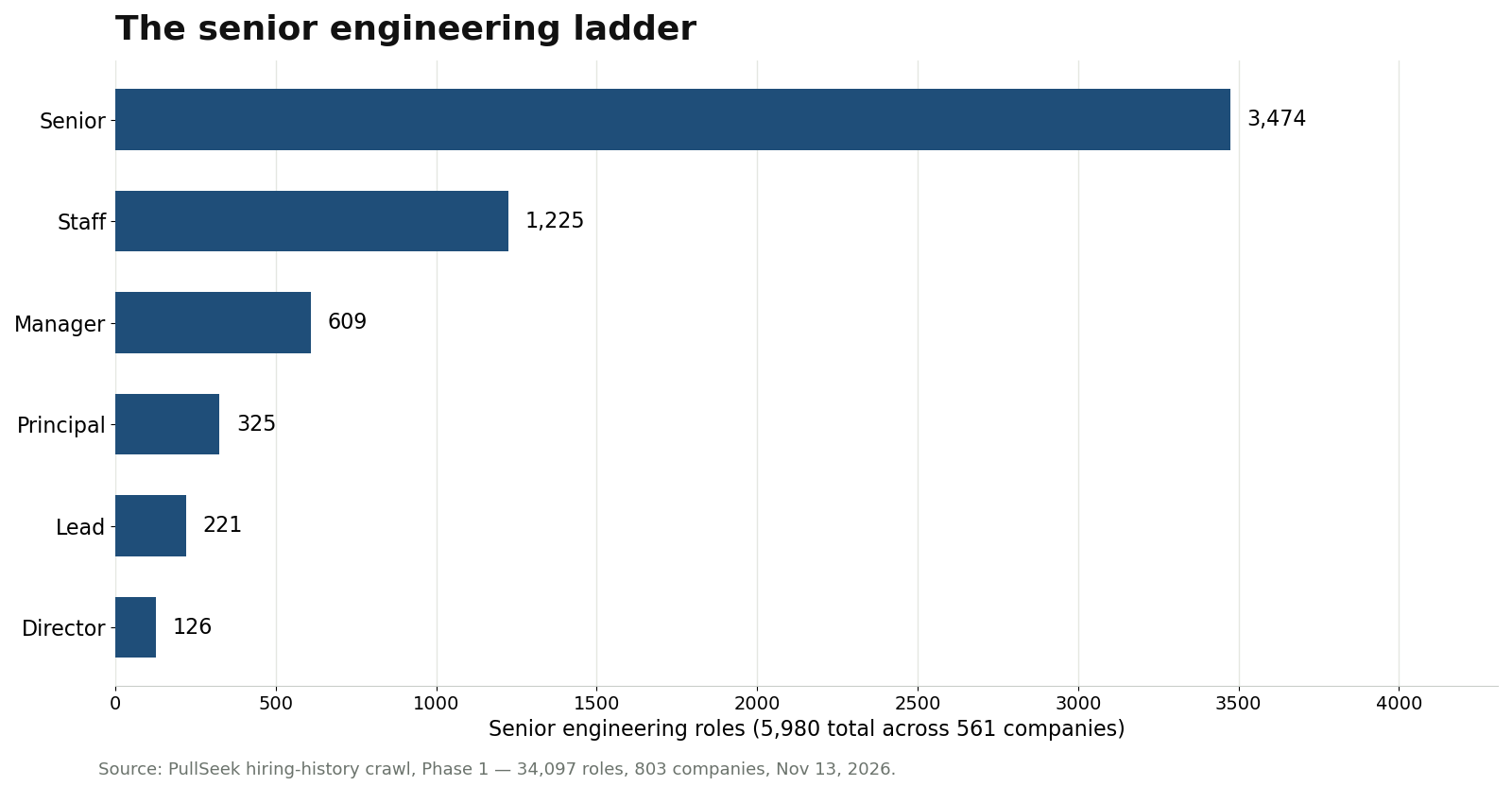
For engineers specifically, the skew is sharper. Of the 10,133 roles with 'engineer' in the title, 5,980 are Senior-level or above — 59.0% of all engineer-titled roles, and 95.9% of the engineer-titled roles that state a level. Those 5,980 senior engineering roles sit across 561 companies. The median company with any senior engineering roles has 4 of them open.
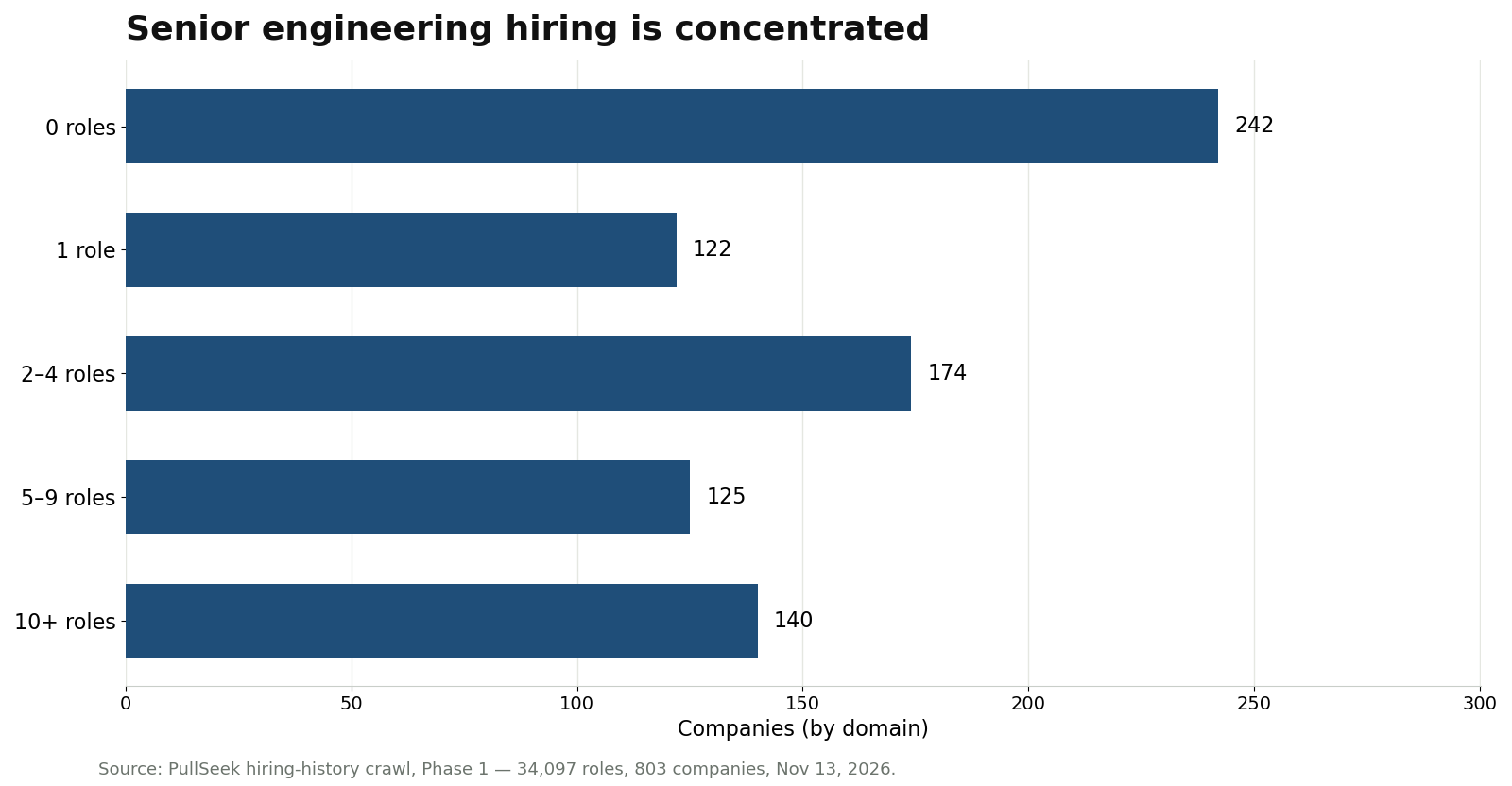
Senior hiring is also concentrated. Of the 561 companies with senior engineering roles open, 140 have 10 or more — and those 140 hold 4,566 of the 5,980 roles, 76.4% of all senior engineering hiring in the file. At the other end, 242 of the 803 companies have no senior engineering role open at all.
That concentration is good news for a senior engineer who is not applying. You do not need to be known by a thousand companies. You need to be known by a handful — the ones doing most of the senior hiring, in the area you work in.
The math of applying
The same pattern shows up in other people's data. A technical hire now takes 291 applications, on average, up from 121 in 2021, according to Ashby's Talent Trends data. In Ashby's analysis of more than 38 million applications across 93,000 jobs, from January 2021 to December 2024, 3% of inbound applicants reached an interview. Referred candidates reached an interview 40% of the time.
That gap is the whole story. The application is not the bottleneck. Being known before the application is.
A referred candidate is not smarter. They are earlier. Someone at the company already knows their name when the req opens. The interview is not a reward for a good resume. It is a conversation with a person the team has already met.
Senior roles are the ones least likely to be filled from a cold application. They are filled by people the hiring manager already trusts, or by someone a trusted person vouches for. The posting is a formality. The hire comes from the network around the team.
The three ways in, without applying
There are really only three ways a senior engineer gets hired without applying. All three start months before the role exists.
1. Someone inside recommends you. This is the most common path. A hiring manager asks their team: who do you know who can do this? A peer names you. A former colleague vouches for you. The recommendation is specific — "she built the billing system at her last company, she can own this" — not a generic endorsement. The strength of the recommendation is the strength of the work the recommender saw.
You cannot manufacture this in a week. It is built over years, by being the person other engineers want to work with again. The practical version of it is simple: stay in touch with the three or four people whose judgment you most respect, and be useful to them before you need anything.
2. The team has seen your work. Senior engineers leave traces. Talks, blog posts, open source, papers, incident write-ups. A hiring manager who has read your work already has an opinion of you before you ever speak. That opinion is worth more than a resume, because it is evidence of how you think, not a claim about what you did.
This is the slowest path and the most durable. It does not require being famous. It requires being specific — writing about the actual problems you solved, in enough detail that a peer can tell you know what you are talking about. One careful post about a real system is worth a hundred generic takes.
3. You were in the room before the role. You met the hiring manager at a conference, in an open-source project, through a mutual connection, months before they had a req. You talked about the work, not about a job. When the role appears, you are not an applicant. You are a person they have already talked to about the problem.
This is the path PullSeek is built for, and it is the one most senior engineers underinvest in. It feels like networking. It is not. Networking is collecting contacts. This is having one real conversation about real work, with the right person, before there is anything to apply to.
What to do if you are not applying anywhere
None of this requires a job search. It requires a short list and a rhythm.
Pick ten companies whose product you understand and whose engineering problems you can talk about without a script. If you cannot name the team's hardest problem, you are too early to reach out — read more first.
For each company, find the people, not the req. Usually three people: the likely hiring manager, the team lead, and one peer on the team you would join. Their public work — talks, blog posts, open source, papers — tells you what they care about. Read it before you write to them.
Then write one short, specific note. Not a resume. Not "I'd love to connect." One paragraph: what you noticed about their team's work, what you have built that is relevant, and a question worth answering. If the note could be sent to any company, delete it and start over.
Then stay in touch without being a nuisance. A useful update every three to four weeks is enough. Something you shipped. A problem you solved that rhymes with theirs. A short comment on their work that shows you read it. The goal is not to be remembered as persistent. It is to be remembered as competent, when the role appears.
And keep it quiet. You are employed. You do not need a public "open to work" badge. A direct note to one person is invisible to your employer and far more effective than a signal to everyone.
What PullSeek does differently
PullSeek exists because this process is hard to do by hand for more than a few companies.
We watch 101,498 fast-growing companies, starting with the US. We predict which roles each one is likely to hire in the next 12 months — the role, the level, and the profile that fits. We map the people behind each predicted role: the likely hiring manager, the team lead, the peers. And we draft the introduction to a specific person, which you approve before anything is sent.
The prediction is the point. A job board tells you what is open now. We tell you what is likely to open next, so the relationship starts before the posting — when it still matters.
Every prediction is graded. When the window closes, we compare the prediction against the job description the company actually published. That score is the product. If the predictions are wrong, nothing else matters.
You do not need PullSeek to do this. Ten companies, three people each, one good note — that works on its own. PullSeek does it at a scale no person can: every company, every signal, every quarter. The work is the same. The coverage is not.
The bottom line
Senior engineers do not get hired by applying. They get hired by being known — by a recommender, by their public work, or by the hiring manager themselves — before the role exists.
The posting is the last step. Start before it.
Methodology
Figures in this post were computed from PullSeek's hiring-history crawl, Phase 1 file: 34,097 roles across 803 companies (by domain), fetched November 13, 2026, from public Greenhouse, Ashby, and Lever job boards. Role levels are as listed on the boards; 14,668 rows (43%) carry no level label. Senior engineering roles are roles with 'engineer' in the title and a level of Senior, Staff, Principal, Lead, Director, or Manager: 5,980 roles across 561 companies. Senior-or-above roles overall (Senior, Staff, Principal, Lead, Director, Manager, VP, Executive) total 18,712, or 54.9% of all roles and 96.3% of the 19,429 roles that state a level. Posting dates are true dates only where the board publishes them (Ashby and Lever); Greenhouse publishes no posting dates, which is why 59.2% of roles in the file have none. Burst counts are computed only on the 13,927 dated roles, by domain.
The wider hiring-history corpus holds 51,129 deduped role rows across 1,611 companies crawled. The PullSeek company directory holds 101,498 companies. The Inc 5000 database holds 5,003 US high-growth companies.
External figures: Ashby Talent Trends — 291 applications per technical hire (2026, up from 121 in 2021); Ashby referrals analysis — 40% of referred candidates reached an interview vs 3% of inbound applicants, from 38 million applications across 93,000 jobs, January 2021 to December 2024 (published May 2025).
Related insights
Start before the posting.
PullSeek predicts the roles companies will hire in the next 12 months and introduces you to the people inside before the job exists. Your first connected role is free.
Get started